Table of Contents >> Show >> Hide
- What Actually Happened?
- Why Earth Took the Hit Differently
- The Moon: No Umbrella, No Roof, No Mercy
- Mars: The Red Planet Got Its Own Solar Punch
- Why These Three Worlds Make the Perfect Comparison
- What Space Agencies Learn From Events Like This
- The Big Takeaway
- Extended Perspective: What This Kind of Solar Storm Feels Like Across Three Worlds
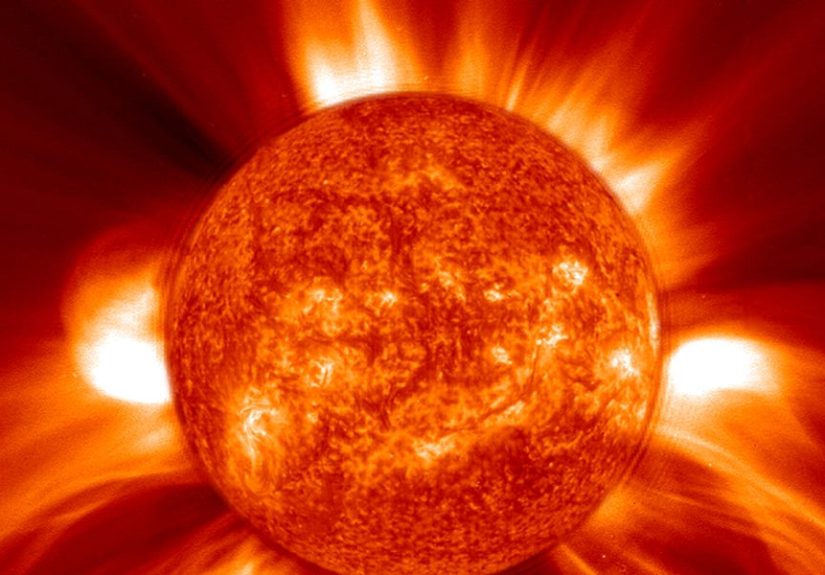
The Sun did not literally explode, which is nice because that would make everyone’s calendar plans irrelevant. But it did unleash something dramatic enough to smack Earth, wash over the Moon, and rattle Marsproof that space weather is not just a fancy phrase scientists use to sound important on conference badges.
The real culprit was a powerful solar eruption: a mix of solar flare energy and a coronal mass ejection, or CME, which is a huge cloud of charged particles and magnetic fields hurled into space. In one especially important case, scientists reported the first ground-level enhancement measured on Earth, the Moon, and Mars from the same event. Then, in May 2024, the Sun followed up with another blockbuster performance: the strongest geomagnetic storm to hit Earth in more than two decades, plus an intense burst that reached Mars days later. Put simply, our star was in a mood.
That combination of events gave researchers something they rarely get in one neat cosmic package: a natural stress test for three very different worlds. Earth has a strong magnetic field and a thick atmosphere. The Moon has basically neither. Mars sits awkwardly in the middle with a thin atmosphere and no global magnetic field. Same Sun. Same broad kind of eruption. Three very different outcomes. That is exactly the kind of comparison space scientists loveand exactly the kind of lesson future astronauts will need.
What Actually Happened?
The headline idea comes from a remarkable solar event tied to an October 2021 CME that spread energetic particles across an enormous stretch of the inner solar system. Scientists later described it as the first time a ground-level enhancement from one solar event was measured on Earth, the Moon, and Mars. In plain English, the solar blast was so broad and strong that detectors on multiple worlds all noticed it. That is not your average “space is neat” story. That is a wake-up call with a plasma soundtrack.
Then came May 2024, when solar activity turned the dial up again. A giant sunspot region produced wave after wave of flares and CMEs. NOAA issued its first severe geomagnetic storm watch since 2005, and G5 conditionsthe highest level on the geomagnetic storm scalewere observed for the first time since 2003. NASA later described the May 2024 event as the biggest geomagnetic storm in 20 years. If the Sun had an agent, this would have been marketed as a comeback tour.
Why Earth Took the Hit Differently
Earth got the flashiest public-facing effects. Auroras spread far beyond their usual turf, showing up in places where people normally do not step outside and expect the sky to look like a neon lava lamp. For many observers, the May 2024 storm felt magical. For mission teams and infrastructure managers, it felt more like a long, caffeinated weekend.
That difference comes down to Earth’s protection system. Our planet’s global magnetic field deflects much of the solar wind, and our atmosphere absorbs a great deal of harmful radiation before it reaches the ground. We still felt the consequences, but mostly through the way space weather disturbed technology and the upper atmosphere. NASA reported that some high-voltage lines tripped, transformers overheated, and GPS-guided tractors in the U.S. Midwest wandered off course. That last detail is a useful reminder that modern civilization runs on invisible systems until the sky decides to edit the rules.
Satellites had their own stressful chapter. NASA Earthdata reported that the storm pushed at least one Earth-observing satellite into safe mode while others came close. Solar storms can change satellite drag, threaten instrument health, and interfere with data transmission. In February 2025, NASA added another twist: scientists found that the May 2024 storm created two temporary new radiation belts around Earth. So even after the sky show faded, the near-Earth environment was still dealing with the aftereffects.
The Moon: No Umbrella, No Roof, No Mercy
If Earth faced the storm with a helmet and a raincoat, the Moon faced it like a guy in flip-flops walking into a hailstorm.
NASA’s explanation of solar wind on the Moon is blunt: the Moon has no global magnetic field and almost no atmosphere, so most of its surface is directly exposed to solar wind and other space radiation. That makes the Moon a fantastic science lab and a fairly rude vacation destination. When solar activity ramps up, the lunar surface does not get the same kind of shielding Earth enjoys. Radiation, surface charging, and electrostatic effects all matter more there.
This is why the “Earth, Moon, and Mars” story matters so much for Artemis-era planning. NASA has repeatedly emphasized that once astronauts leave Earth’s protective magnetic environment, they enter a much harsher radiation regime. Space radiation is not just a vague background danger. It can affect the human body, damage electronics, complicate surface operations, and dictate when crews should shelter in place. Deep-space measurements from missions like BioSentinel help scientists understand what happens beyond Earth’s protective bubble, including during major solar storms.
The Moon also forces a design question that sounds simple and is absolutely not: where do astronauts hide when the Sun throws a tantrum? Habitats may need thicker shielding. Surface timelines may need to bend around space weather forecasts. Equipment needs to tolerate radiation spikes and static charging. In other words, the Moon is close, but it is not cozy.
Mars: The Red Planet Got Its Own Solar Punch
Earth’s aurora weekend was not the end of the story. Days later, Mars got tagged by a major solar event of its own. NASA’s Mars missions provided a front-row seat, and the data were both beautiful and slightly alarming.
During the May 20, 2024 event, NASA’s Curiosity rover measured a radiation dose of 8,100 micrograys, roughly equivalent to 30 chest X-rays. NASA said it was the biggest surge measured by Curiosity’s Radiation Assessment Detector since the rover landed. Not deadly, but definitely not the kind of thing you want in the “minor inconvenience” column of a mission checklist.
The storm also made itself visible in wonderfully weird ways. Curiosity’s navigation cameras showed streaks and specksbasically static snow caused by energetic particles slamming into the detector. Meanwhile, Mars Odyssey’s star camera was temporarily overwhelmed and dropped out before recovering. MAVEN, orbiting above, observed auroras spread across the Martian nightside. Unlike Earth’s auroras, which are usually funneled toward the poles by a global magnetic field, Mars can glow much more broadly because it lacks that large-scale shield.
And that lack of a global magnetic field is not just a current hazard. It is part of Mars’ long history. NASA has shown for years that solar wind and solar storms help strip away the Martian atmosphere. That is one reason Mars transformed from a wetter, more Earth-like world into the cold, dry planet we know today. So when Mars gets hit by a solar eruption, scientists are not just watching a weather event. They are also watching a process that has shaped the planet over billions of years.
Why These Three Worlds Make the Perfect Comparison
Earth, the Moon, and Mars are like three test cases in the same cosmic experiment.
Earth
Protected by a strong magnetic field and a thick atmosphere, Earth often turns dangerous incoming solar particles into auroras, radio disruptions, GPS errors, and satellite headaches instead of a full radiation disaster at the surface.
The Moon
With no global magnetosphere and almost no atmosphere, the Moon is far more exposed. Solar particles can interact directly with the surface, charge dust, affect electronics, and raise risks for astronauts working outside protected habitats.
Mars
Mars offers some atmospheric protection, but not enough to act like Earth. Its missing global magnetic field leaves it vulnerable to broad auroras, atmospheric loss, and sharper radiation concerns for long-term human missions.
That is why scientists get excited when one solar eruption can be tracked across more than one world. It allows them to compare how the same kind of solar energy behaves in very different environments. For researchers, this is gold. For future explorers, it is survival homework.
What Space Agencies Learn From Events Like This
First, forecasting matters more than ever. NOAA and NASA already monitor the Sun constantly, but the Moon-and-Mars era raises the stakes. It is one thing to warn airline operators, power grid managers, and satellite teams. It is another to warn astronauts traveling outside Earth’s magnetosphere, where bad timing can turn a science sortie into a radiation emergency.
Second, shielding strategy matters. On Mars, researchers have pointed to cliffsides, lava tubes, and terrain-based shelter as possible protection during solar storms. On the Moon, habitats, vehicles, and even mission schedules may need to be built around exposure limits and storm shelters. This is not glamorous sci-fi wallpaper. It is the nuts-and-bolts question of how not to fry your crew.
Third, instruments matter. Every detector that records radiation spikes, atmospheric response, auroral glow, or magnetic disruption improves the model for the next event. Today’s robotic measurements become tomorrow’s human safety manual. That is why a storm hitting multiple worlds is not just a cool headline. It is a rehearsal for deep-space living.
The Big Takeaway
The story hidden inside this dramatic headline is not that the solar system is suddenly unsafe. It is that we are finally learning how to read the Sun’s behavior across multiple worlds at once. That is a big deal.
The October 2021 event showed that one solar eruption could be detected on Earth, the Moon, and Mars in a single sweeping episode. The May 2024 storms reminded us that the Sun is still perfectly capable of shaking Earth’s magnetic environment, scrambling satellites, and hammering Mars with measurable radiation. Together, these events underline the same message: space weather is not local weather. It is interplanetary.
And that matters because humanity is trying to become interplanetary too. We want astronauts orbiting the Moon, working on the lunar surface, and eventually walking on Mars. None of that happens safely unless we understand the Sun not just as a life-giving star, but as an occasionally unruly engine of charged-particle chaos. Beautiful chaos, sure. Instagrammable chaos, absolutely. Still chaos.
Extended Perspective: What This Kind of Solar Storm Feels Like Across Three Worlds
On Earth, an event like this can feel oddly split between wonder and inconvenience. One half of the world sees brilliant auroras rippling across skies that almost never host them. People pull over on highways, crowd porches, and point their phones upward like the universe just dropped a surprise concert. The other halfengineers, forecasters, satellite operators, and power managersstays glued to data streams, because every beautiful curtain of light is a sign that charged particles are wrestling with the planet’s magnetic field. It is one of the few natural events that can be breathtaking and technically annoying at the exact same time.
If you shift that experience to the Moon, the mood changes fast. There is no thick atmosphere to soften the scene and no strong global magnetic shield to redirect the danger. A big solar event on the Moon would not announce itself with a massive public light show over crowded cities. It would be quieter, harsher, and more operational. The concern would be radiation dose, surface charging, instrument noise, and whether astronauts could get to shelter quickly enough. A lunar crew would not be standing around saying, “Wow, look at that.” They would be checking timelines, storm alerts, suit exposure limits, and habitat procedures.
Mars offers a stranger middle ground. It has enough atmosphere to make the story different from the Moon, but not enough to make anyone feel truly comfortable. A strong solar storm there can paint the sky with planet-wide auroras while also driving radiation levels high enough to reshape mission planning. NASA’s May 2024 observations make that feel especially real. Curiosity did not merely confirm that something happened. It measured the surge. Odyssey did not merely imply that the storm was intense. It reacted to it. That is the kind of evidence that takes “future astronaut safety” out of the abstract and drops it right onto a checklist.
There is also a psychological side to these events that does not get enough attention. Solar storms remind us that space is dynamic, not decorative. We grow up with images of planets looking still and majestic, like museum pieces with good lighting. But the actual solar system is busy. It crackles. It surges. It strips atmospheres, bends magnetic fields, triggers auroras, and occasionally slaps cameras with a burst of energetic particles just to make the point clear. The Sun is not a distant lamp. It is the central machine in the neighborhood, and every world deals with it differently.
That is why these cross-world measurements are so valuable. They turn a dramatic event into something useful. They let scientists compare protection, exposure, and response from one planetary environment to another. They help engineers think about shielding, alert systems, and safer mission architecture. And they help the rest of us understand that when a headline says Earth, the Moon, and Mars all got hit by a sun explosion, it is not tabloid exaggeration with a space sticker slapped on top. It is a vivid way of saying that our star can touch multiple worlds at onceand that learning from those moments may be one of the most practical things space science can do.
Note: In this article, “sun explosion” is a plain-English shorthand for solar flares and coronal mass ejections, not the literal destruction of the Sun.