Table of Contents >> Show >> Hide
- What Makes a “Double-Almond” Macaron?
- Ingredients
- Equipment You’ll Be Glad You Used
- Step-by-Step: Double-Almond Macaron Shells
- Almond Buttercream-Style Filling
- Assemble + Mature (Yes, Patience Is an Ingredient)
- Macaron Troubleshooting (Because Macarons Have Opinions)
- Flavor Variations That Still Keep the “Double-Almond” Soul
- Storage Tips
- FAQ
- Conclusion: Almond Joy, But Make It Fancy
- Kitchen Notes: Real Experiences with Double-Almond Macarons (The Good, the Weird, and the Delicious)
If regular macarons are a little fancy, double-almond macarons are the ones wearing sunglasses indoors.
You get the classic crisp shell + chewy center, but with an almond flavor that actually shows up to the party:
almond flour in the shells and almond extract (plus an almond-forward filling). Yes, they’re a bit
“high maintenance.” But so is your best friend, and you still love them.
This guide gives you a reliable French-method macaron workflow, a creamy almond-buttercream-style filling,
and the specific “why did mine do that?” troubleshooting that turns macaron stress into macaron swagger.
What Makes a “Double-Almond” Macaron?
Traditional French macarons already lean on almond flour for structure and that signature tender bite.
A double-almond macaron takes it further by layering almond flavor in two places:
- Shells: Almond flour + a small hit of almond extract (optional, but recommended for “double”).
- Filling: An almond-kissed buttercream (with the option to add creamy almond butter for extra depth).
The result tastes like an almond croissant and a fancy cookie had a delightful little baby.
And unlike almond “flavor” that sometimes reads as “mystery bakery perfume,” this version stays warm, nutty, and clean.
Ingredients
For the Double-Almond Macaron Shells (French Method)
Macarons reward precision, so weights are included. If you use cups, be gentle and consistentdon’t pack anything.
- Egg whites: 3 large (about 90–100g), room temperature
- Almond flour: 1 1/4 cups (about 120–130g), finely ground
- Powdered sugar: 1 1/4 cups (about 140–160g), sifted
- Cream of tartar: 1/8 tsp (or a pinch of fine salt if that’s what you’ve got)
- Granulated sugar: 1/4 cup (about 50g)
- Almond extract: 1/4 tsp (use a light handalmond extract can get loud)
- Optional: A drop or two of gel food coloring (avoid liquid coloring; extra moisture can sabotage you)
For the Almond “Butter” Frosting (Almond Buttercream-Style Filling)
- Unsalted butter: 3 Tbsp, softened
- Powdered sugar: 2 cups, sifted if lumpy
- Milk: 1 Tbsp + more by teaspoons if needed
- Almond extract: 1/2 tsp
- Optional (highly almond-y): 1–2 Tbsp creamy almond butter (adds depth and true “almond butter” vibes)
Equipment You’ll Be Glad You Used
- Kitchen scale (macarons love accuracy)
- Fine-mesh sieve
- Food processor (optional, for ultra-smooth shells)
- Stand mixer or hand mixer
- Piping bag + round tip (about 1/4 inch)
- Two baking sheets + parchment paper (or silicone mats)
- Small offset spatula (nice for filling)
Step-by-Step: Double-Almond Macaron Shells
1) Prep like you mean it
- Let egg whites sit at room temperature for about 30 minutes.
- Line two baking sheets with parchment. If you want perfectly uniform circles, place a template under the parchment and remove it before baking.
- Fit a piping bag with a round tip and set it in a tall glass (your future self will thank you).
2) Make the “tant pour tant” (almond flour + powdered sugar)
- Combine almond flour and powdered sugar. If you have a food processor, pulse or process for about 1 minute to refine the texture.
- Sift the mixture through a fine sieve into a bowl. Press gently to help it pass through.
- Discard any coarse bits left behind (a tablespoon or so is normal). Big chunks = bumpy shells.
3) Whip the meringue to glossy peaks
- Add cream of tartar to the egg whites.
- Beat on medium until frothy (about 1 minute).
- Gradually add granulated sugar. Increase speed to high and whip until the meringue is stiff, glossy, and holds a peak that stands up with only a slight bend.
- Add almond extract (and gel coloring, if using) and mix briefly just to combine.
What you’re looking for: The meringue should look shiny and dense, not dry or clumpy.
If it looks like cottage cheese clouds, you’ve gone too far and the batter can turn grainy.
4) Macaronage: fold to the “lava ribbon” stage
- Add the sifted almond-sugar mixture to the meringue.
- Fold gently at first to combine, then continue folding until the batter flows off the spatula in a smooth ribbon.
- Do a ribbon test: the batter should fall in ribbons that melt back into the surface in about 10–20 seconds.
Macaronage is the make-or-break moment. Under-mixed batter pipes with peaks and bakes lumpy.
Over-mixed batter spreads too much and bakes flat. Aim for “slow lava,” not “pancake batter” and not “stiff frosting.”
5) Pipe, tap, and pop bubbles
- Transfer batter to the piping bag.
- Pipe 1 1/4-inch circles about 1 inch apart, holding the bag straight up and down.
- Firmly tap each tray against the counter 5–8 times to release air bubbles.
- If you see visible bubbles on top, pop them with a toothpick.
6) Rest until a skin forms
Let the trays sit at room temperature for 30–45 minutes (sometimes longer in humid weather)
until the tops feel dry and no longer sticky to a gentle touch. This dry “skin” helps create the famous macaron feet.
7) Bake for crisp shells and proper feet
- Preheat oven to 300°F. (An oven thermometer helpsmany ovens are enthusiastic liars.)
- Bake one tray at a time for about 16–18 minutes.
- They’re done when the tops are set and don’t slide around if you nudge a shell gently.
- Cool completely on the tray before peeling off parchment.
Almond Buttercream-Style Filling
Quick filling method
- Beat softened butter until smooth.
- Beat in 1 cup powdered sugar, 1 Tbsp milk, and almond extract.
- Add remaining powdered sugar and beat until fluffy.
- If using almond butter, beat it in now.
- Adjust texture with extra milk, 1 tsp at a time, until spreadable or pipeable.
Flavor tip: If you want “toasted almond” vibes, add a tiny pinch of salt. It doesn’t make it salty;
it makes the almond flavor taste more… almond-y.
Assemble + Mature (Yes, Patience Is an Ingredient)
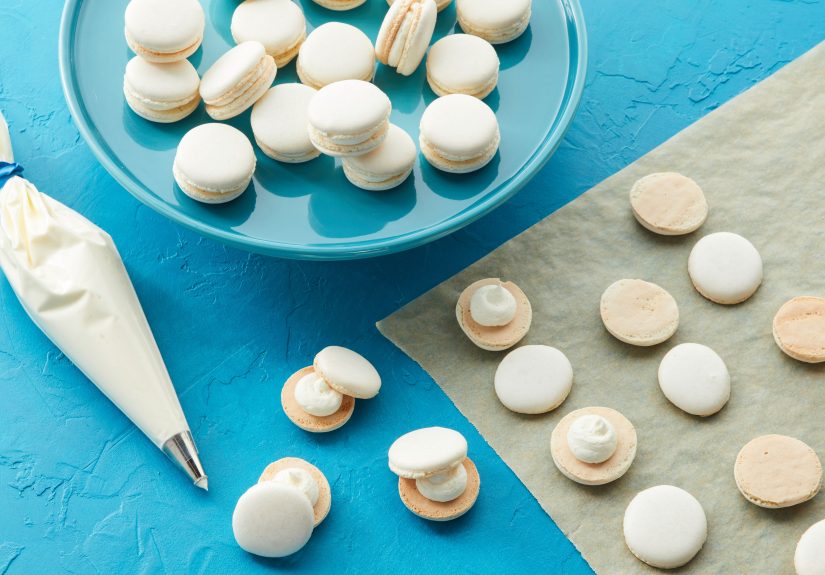
- Match shells by size (the cutest couples win).
- Pipe or spread filling onto the flat side of half the shells.
- Top with remaining shells and press gently until filling reaches the edges.
- For best texture, refrigerate assembled macarons 12–24 hours in an airtight container.
- Bring to room temp for 15–20 minutes before serving.
That resting time is where the magic happens: the filling hydrates the shells slightly, giving you that
signature tender-chewy bite instead of “crunchy meringue with commitment issues.”
Macaron Troubleshooting (Because Macarons Have Opinions)
No feet
- Likely causes: Batter over-mixed, shells not rested long enough, oven too cool.
- Fix: Rest until truly dry; bake at a verified 300°F; stop macaronage at the ribbon stage.
Cracked tops
- Likely causes: No skin formed, oven too hot, trapped air bubbles.
- Fix: Rest longer, tap trays firmly, pop bubbles, and consider lowering oven temp by 10–15°F if your oven runs hot.
Hollow shells
- Likely causes: Under-baking, unstable meringue, oven temp issues.
- Fix: Bake a minute or two longer; ensure meringue is glossy-stiff; verify oven temp with a thermometer.
Sticky bottoms
- Likely causes: Under-baked or too much moisture.
- Fix: Bake slightly longer; cool fully before peeling; use parchment that’s flat and dry.
Lopsided shells
- Likely causes: Uneven oven heat or angled piping.
- Fix: Pipe straight down; rotate tray halfway through if your oven has hot spots.
Flavor Variations That Still Keep the “Double-Almond” Soul
- Toasted almond: Add a few tablespoons of finely chopped toasted almonds to the filling (not the shellskeep shells smooth).
- Cherry-almond: Add a thin swipe of cherry jam under the filling for a bakery-style surprise.
- Chocolate-almond: Replace 10g of powdered sugar with 10g cocoa in the dry mix and keep almond extract in the meringue.
- Salted honey-almond: Mix a teaspoon of honey into the filling and finish with a pinch of flaky salt on top after assembling.
Storage Tips
- Room temperature: In an airtight container for up to 2–3 days (cool, dry kitchen).
- Refrigerator: Up to 5–7 days, airtight. Bring to room temp before eating.
- Freezer: Freeze assembled macarons in a sealed container for up to 1–2 months. Thaw overnight in the fridge.
FAQ
Do I really need to sift?
Yesif you want smooth shells. Sifting removes coarse almond bits that cause bumps and weak spots.
Think of it as exfoliating… for cookies.
Can I use almond meal instead of almond flour?
Almond meal is usually coarser and can create bumpy shells and unpredictable texture.
Fine almond flour is your best bet for consistent, bakery-style results.
French method or Italian methodwhat’s better?
French method is simpler (no sugar syrup). Italian method is more stable but adds complexity.
This recipe uses the French method because it’s practical for home bakers and still delivers beautiful results.
Conclusion: Almond Joy, But Make It Fancy
Double-almond macarons are the kind of dessert that makes people assume you own matching linen napkins.
In reality, you just learned the rhythm: whip a glossy meringue, fold to the ribbon stage, rest until dry,
bake with steady heat, then let the filled cookies mature into that perfect crisp-chewy bite.
And if your first batch looks a little… abstract? Congratulations: you’re officially a macaron maker.
Bake again, tweak one variable at a time, and soon you’ll have a tray of almond-scented little sandwiches
that disappear faster than your willpower near a bakery case.
Kitchen Notes: Real Experiences with Double-Almond Macarons (The Good, the Weird, and the Delicious)
The first time you make macarons, they feel less like a recipe and more like a personality test.
Are you patient? Are you precise? Are you emotionally prepared to stare through an oven window like you’re watching a suspense thriller?
Double-almond macarons raise the stakes because almond extract smells so amazing that you’ll want to sprint aheadthen the batter
reminds you that macarons operate on their own schedule.
One of the biggest “aha” moments is realizing how much the batter changes during macaronage. In the bowl, it’s dramatic:
it goes from fluffy and stubborn to glossy and cooperative in what feels like three folds… and then it’s suddenly
one fold away from being over-mixed. The most helpful habit is doing the ribbon test early and often. I like to lift the spatula,
let the batter fall back into the bowl, and count slowly. If the ribbon sits on top like it’s proud of itself, it needs more folding.
If it vanishes immediately, you’ve gone a little too far and should pipe ASAP before it spreads into macaron puddles.
Resting is the other place where experience makes you smarter than a timer. On a dry day, 30 minutes can be plenty.
On a humid day, 45 minutes is a cute suggestion, like “maybe bring a jacket” in the middle of a snowstorm.
The shells have to feel dry to the touchno stickiness, no tacky spotsbecause that skin is what helps the cookies rise
and form feet instead of cracking like tiny almond volcanoes.
Oven behavior is its own saga. Some ovens run hot, some run cool, and some have “moods.” A simple oven thermometer turns guesswork
into facts, and facts are macaron-friendly. If you notice hollow shells, it’s tempting to blame the recipe, but it’s often
a heat problemeither the oven isn’t hot enough to set the structure, or the bake time is a hair too short. Adding a minute or two
can be the difference between “pretty but empty” and “full, sturdy shells that don’t shatter when you look at them.”
The filling is where double-almond macarons become truly addictive. Almond extract in the buttercream gives that bakery aroma,
but adding a spoonful of creamy almond butter makes the flavor rounderless “sharp almond perfume,” more “warm toasted nut.”
It also gives the filling a slightly richer body, which helps the macarons mature beautifully overnight.
That maturing step feels unnecessary until you taste the difference: freshly filled macarons can be a bit crunchy and separate,
but after 12–24 hours, the shell and filling behave like they were made for each other (which… they were).
And yes, there’s always a “learning batch.” Mine taught me that piping angle matters (straight down is non-negotiable),
tapping the tray is not optional (air bubbles love chaos), and almond extract should be measured with respect.
Once you’ve made them a couple of times, though, you stop fearing the process and start enjoying it. You’ll recognize the right
batter texture, you’ll know your oven’s quirks, and you’ll have a freezer stash of macarons that makes random Tuesdays feel like
a celebration. That’s the real macaron win: not perfection on day one, but the confidence that you can make a tray of almond-scented,
glossy little cookies whenever you feel like showing offquietly, deliciously, and with minimal napkin coordination.