Table of Contents >> Show >> Hide
- Why a “Forest Chandelier” Works So Well
- Four Ways a Chandelier Can Turn a Room Into a Forest
- Pick Your Forest: Styles That Actually Work in Real Homes
- Proportion and Placement: Where Forest Chandeliers Go Wrong
- Light Quality: Make It Feel Like Sun Through Trees
- Greenery Options: Faux vs. Live (Choose Your Difficulty Level)
- Safety First: Keep the Forest Magical, Not Flammable
- How to Get the Look Without Rebuilding Your Whole Room
- Budget Reality: From “Crafty Weekend” to “Designer Statement”
- A Quick “Forest Chandelier” Plan You Can Pull Off This Weekend
- Experiences: What It’s Like to Live Under a “Forest Chandelier” (Plus What People Learn Fast)
- Conclusion
There are two types of ceilings in this world: the kind that quietly exists, and the kind that says,
“Welcome to my enchanted woodland, please remove your shoes and your emotional baggage.”
A “forest chandelier” is firmly in the second category. It’s lighting, yesbut it’s also atmosphere,
set design, and a tiny bit of sorcery (the legal kind, powered by LED).
The idea is simple: use a chandelier to mimic what you feel under treesdappled light, organic shapes,
leafy textures, and that calming “I should stop doomscrolling” energy. Done right, a forest chandelier
can turn a bland room into a canopy moment: cozy, grounded, and just dramatic enough to make your
dinner guests look up mid-sentence.
Why a “Forest Chandelier” Works So Well
Designers have a name for the “bring the outdoors inside” instinct: biophilic design.
It’s not just a vibeit’s a strategy that uses natural elements (plants, natural materials, views,
shadow patterns, and daylight cues) to help a space feel better to live in. People tend to relax when
they’re surrounded by nature-like signals, even indoors.
A chandelier is uniquely powerful because it sits in your upper visual fieldright where “forest canopy”
belongs. Most décor lives at eye level, but a forest chandelier creates that overhead layer that makes
a room feel immersive. It’s the difference between hanging a picture of the woods and feeling like you
could hear a woodpecker if you listened hard enough.
Four Ways a Chandelier Can Turn a Room Into a Forest
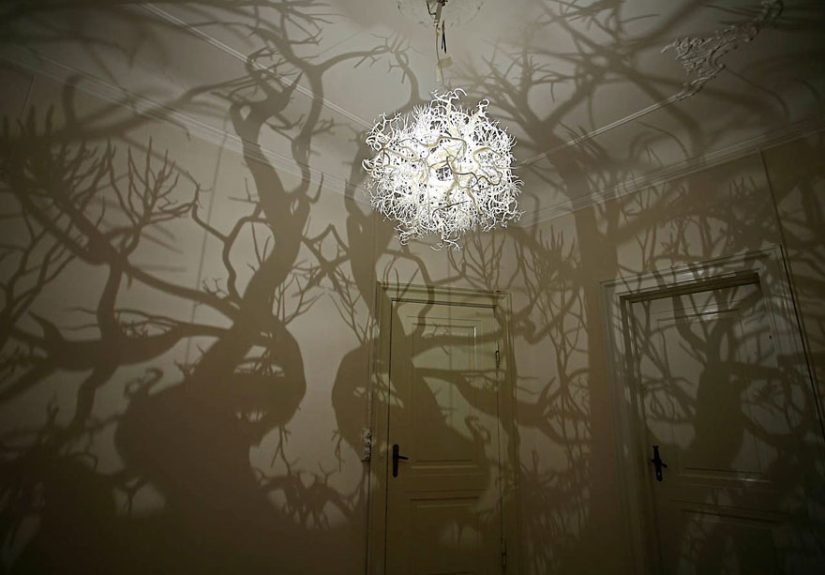
1) Shadow-Play: Branches on the Walls
Some chandeliers (or pendant sculptures) are designed to cast intricate shadowslike branches, roots,
or leaf clustersonto walls and ceilings. When the light hits a web of organic shapes, your room gets
that “late-afternoon sun through trees” effect. This approach is especially striking in rooms with
lighter walls, where shadows read as soft, moving artwork.
2) Botanical Structure: Branch Forms and Twig Silhouettes
A branch-style chandeliermetal, wood, resin, or mixed materialsbrings an unmistakably natural outline
to the space. Think of it as jewelry for the ceiling: sculptural arms like limbs, bulbs like fireflies,
and a silhouette that says “I have opinions about hiking snacks.”
3) Greenery Add-Ons: The “Living Canopy” Look
This is the crowd-pleaser: wrap greenery around a chandelier frame, or build a hoop-and-vine installation
that hangs like a floating wreath. You can go faux (low-maintenance, always camera-ready) or use live
plants (real texture, real growth, real responsibility). Either way, you’re creating a canopy layer
overhead, which instantly reads as “forest.”
4) Material Illusions: Leaves, Glass, and Nature Colors
Not everyone wants actual branches above their table (fair). A subtler forest chandelier uses leaf-like
glass pieces, petal shapes, capiz-inspired shimmer, or warm natural finishes (wood tones, linen shades,
bronze, aged brass). Pair that with dimmable warm lighting and natural textiles below, and the forest
feeling shows up without a single twig.
Pick Your Forest: Styles That Actually Work in Real Homes
The Moody Woodland (Great for Dining Rooms)
Go for a darker branch chandelier in bronze/blackened metal, add warm bulbs, and let the shadows do the
storytelling. This look is “cozy cabin,” even if you live in a third-floor condo with a view of the
parking lot. Add linen curtains and a wood table, and the room suddenly wants you to serve soup in a bowl
that costs more than your first car.
The Airy Canopy (Perfect for Living Rooms and Bedrooms)
Choose lighter finishespale wood, soft gold, matte whiteand keep the greenery delicate (eucalyptus
vibes, trailing shapes, soft leaf textures). This makes a room feel calm rather than themed.
The energy is “quiet morning in the trees,” not “haunted forest, but make it fashion.”
The Botanical Statement (Entryways and High Ceilings Love This)
If you have height, use it. Oversized installationsgreenery hoops, layered vines, or multi-tiered
leaf clusterslook incredible in foyers and stairwells. A dramatic piece overhead can make even a plain
entry feel intentional, like the house is wearing its good outfit.
The Modern Biophilic Minimalist (For People Who Hate Clutter)
Choose a clean-lined chandelier and add forest cues around it: a large plant nearby, wood accents, woven
textures, and lighting that mimics natural daylight changes (dimmer at night, brighter in the morning).
You get the benefits of biophilic design without turning your ceiling into a craft project.
Proportion and Placement: Where Forest Chandeliers Go Wrong
The fastest way to ruin the magic is poor sizing. Too small, and the “forest” looks like a sad shrub.
Too big, and it looks like the chandelier is trying to pay rent in your home.
- Over a dining table: A common guideline is to hang the chandelier roughly
30–36 inches above the tabletop, adjusting higher for taller ceilings. - In open areas: Aim for about 7 feet of clearance from the floor to
the bottom of the fixture so people can walk under it comfortably. - Size rule of thumb: Many designers use room dimensions to estimate chandelier diameter
so the fixture visually “belongs” in the space.
Also consider sightlines: you want guests to see the chandelier as an experience, not as an obstacle
hovering over someone’s forehead during dinner conversation.
Light Quality: Make It Feel Like Sun Through Trees
Forest chandeliers are not just about shapethey’re about the kind of light you create.
If the chandelier is the canopy, the bulbs are your “sun.”
- Use LED bulbs to reduce heat (important if you’re adding greenery).
- Add a dimmer so the room can shift from “day hike” to “evening campfire.”
- Layer lighting (floor lamps, sconces, table lamps) so the chandelier isn’t doing
all the emotional labor.
For the most forest-like effect, aim for warm, gentle light at night and brighter, clean light during
the day. The goal is “dappled and cozy,” not “interrogation room chic.”
Greenery Options: Faux vs. Live (Choose Your Difficulty Level)
Faux Greenery: The Reliable Overachiever
Faux vines and stems are perfect if you want the look year-round with minimal maintenance. They’re also
great for people who travel, forget to water, or have a history of “accidentally” turning plants into
crispy décor. Choose high-quality faux greens with varied leaf sizes and realistic color shiftsflat,
shiny plastic reads less “forest” and more “discount rainforest-themed party.”
Live Greenery: Beautiful, But It Comes With Homework
Live plant chandeliers can be stunning, especially with trailing plants. But they require planning:
watering, dripping, weight, and light needs all matter.
Good candidates for a hanging, canopy-like feel (depending on your light conditions) often include
trailing houseplants known for adaptabilitythink vines rather than fussy flowering plants. Use liners
or hidden drip trays where possible, and remember: a plant’s weight increases after watering.
Safety First: Keep the Forest Magical, Not Flammable
A forest chandelier should feel like a retreatnot a home improvement plot twist. Because lighting and
overhead installations involve weight and electricity, keep safety rules non-negotiable.
- Support matters: Heavy fixtures may require a support brace or a properly rated ceiling box.
If you’re unsure what’s in your ceiling, consult a licensed electrician. - Mind the weight: This is crucial for plant add-ons. Watered soil is heavier than it looks.
Choose hardware rated above your total load. - Keep greenery away from bulbs: Use LEDs and maintain clearance so leaves don’t touch hot
surfaces or block ventilation. - Don’t “DIY” wiring: Swapping décor elements is one thing; electrical work is another.
If your project goes beyond cosmetic changes, bring in a pro.
How to Get the Look Without Rebuilding Your Whole Room
The chandelier can lead, but the room has to follow. To sell the “forest” illusion, support it with a few
grounded moves:
- Natural textures: wood, rattan, jute, linen, stone-like finishes.
- Organic shapes: curved furniture, imperfect edges, woven baskets.
- Green accents: not everywherejust enough to echo the chandelier.
- Nature imagery: subtle botanical prints or landscape art (avoid turning it into a theme park).
Budget Reality: From “Crafty Weekend” to “Designer Statement”
You can create a forest chandelier effect at almost any price point:
- Budget-friendly: add faux greenery to an existing chandelier, or use a hoop form and
greenery stems to create a suspended “canopy.” - Mid-range: buy a branch-inspired fixture and keep the greenery minimal and polished.
- High-end: invest in sculptural fixtures that emphasize shadow patterns, artisan materials,
or custom installations designed for your room’s scale.
The best version isn’t the most expensiveit’s the one that fits your space, lighting needs, and tolerance
for maintenance. Know yourself. Be honest. Your ceiling deserves the truth.
A Quick “Forest Chandelier” Plan You Can Pull Off This Weekend
- Decide the vibe: moody woodland, airy canopy, botanical statement, or modern minimalist.
- Check scale: measure the room and the surface below (table or floor clearance).
- Choose light quality: LED bulbs + dimmer if possible.
- Add forest texture: greenery wrap, leaf accents, or branch silhouette.
- Anchor the room: add one or two natural textures nearby (rug, bowls, wood tones, plants).
You’re not trying to build the Amazon rainforest inside your house. You’re creating a feeling:
calm, layered, natural, and a little bit magical.
Experiences: What It’s Like to Live Under a “Forest Chandelier” (Plus What People Learn Fast)
A forest chandelier changes how a room behavessocially, visually, even emotionally. Homeowners who lean into
biophilic details often notice the room becomes a “landing spot,” the place everyone drifts toward without
being told. You walk in, glance up, and your brain reads canopy. It’s subtle, but it’s real: the ceiling
stops being dead space and starts feeling like part of the environment.
In dining rooms, the effect can be immediate. With dimmable light and branchy shadows, dinner feels longer
(in a good way). People linger. Conversations slow down. The chandelier becomes the room’s shared point of
attentionlike a fireplace, but overhead. It’s common for guests to comment on how “cozy” the space feels,
even if nothing else changed. And the host discovers a funny truth: when the lighting is right, the salad
looks more impressive and everyone suddenly forgives you for serving the same chicken recipe again.
In living rooms, the forest chandelier tends to act like a mood filter. During the day, it’s sculptural
an object that makes the space feel designed. At night, it becomes ambient and cinematic. People often
describe the room as “softer,” especially when the chandelier’s shadows land on pale walls. It’s also one
of those upgrades that makes ordinary routines feel elevated: reading on the couch, doing homework at the
coffee table, even folding laundry becomes slightly less tragic when your ceiling looks like a canopy.
The “lessons learned” show up fast, too. If you use live greenery, you’ll discover that watering schedules
are not a suggestion. You’ll also learn to respect gravity: dripping is real, and so is the surprise weight
of a freshly watered plant. People who switch to faux greenery often do so after one dramatic moment involving
a drip tray that was “probably fine.” (It was not fine.) The happy medium for many homes is a mostly faux
canopy with one or two live trailing plants nearby at eye leveleasy to care for, still lush, no ceiling drama.
Seasonality becomes part of the fun. Some households treat the chandelier like a rotating display: evergreen
touches in winter, airy eucalyptus in spring, fuller leafy greens in summer, and warmer tones in fall. That
small change can make the whole room feel refreshed without buying new furniture or repainting. It’s the décor
version of changing your phone wallpaperexcept everyone can see it and compliment you for it.
The biggest “experience” takeaway is this: a forest chandelier doesn’t just decorate a roomit scripts it.
It nudges people to look up, slow down, and feel enclosed in a comforting way. If your home has ever felt a
little too boxy, too bright, or too “everything is fine” in a suspicious way, this is one of the most
satisfying upgrades you can make. You’re not adding clutter. You’re adding canopy. And honestly, the world
could use more canopy.
Conclusion
A chandelier that turns a room into a forest is the rare design move that’s both dramatic and practical:
it upgrades your lighting while changing the entire emotional temperature of the space. Whether you choose
a sculptural branch fixture, a greenery-wrapped canopy, or a leaf-inspired statement piece, the key is balance:
good proportions, thoughtful light quality, and safe installation. Get those right, and your room won’t just
look betterit’ll feel like a place you actually want to be.