Table of Contents >> Show >> Hide
- What Really Happened With Angelina Jolie’s Matching Tattoo
- From Sweet Gesture To Online Outrage
- Angelina Jolie, Tattoos, And Life Under A Microscope
- Is A Matching Tattoo With A Teen Really That Extreme?
- What The “Stay Gold” Ink Says About Their Relationship
- What This Drama Really Reveals About Us
- 500 Extra Words: Lived (And Tattooed) Experiences Around Parents & Teen Ink
The internet can scroll peacefully past a thousand serious problems and then suddenly lose its collective mind over
a few centimeters of ink. Case in point: Angelina Jolie revealing that she and her teen daughter share a matching
tattoo – and instantly being told she’s a “bad mom,” “gross,” and, of course, that classic internet verdict:
“Shame on her.”
So what actually happened? Did Angelina drag her kid to a tattoo studio against her will? Is this a crime against
parenting, or just another episode of People On The Internet Need A Hobby? Let’s walk through the story,
what the tattoo really means, why some people are furious, and what this says about parenting, body autonomy, and
our ongoing obsession with celebrity moms.
What Really Happened With Angelina Jolie’s Matching Tattoo
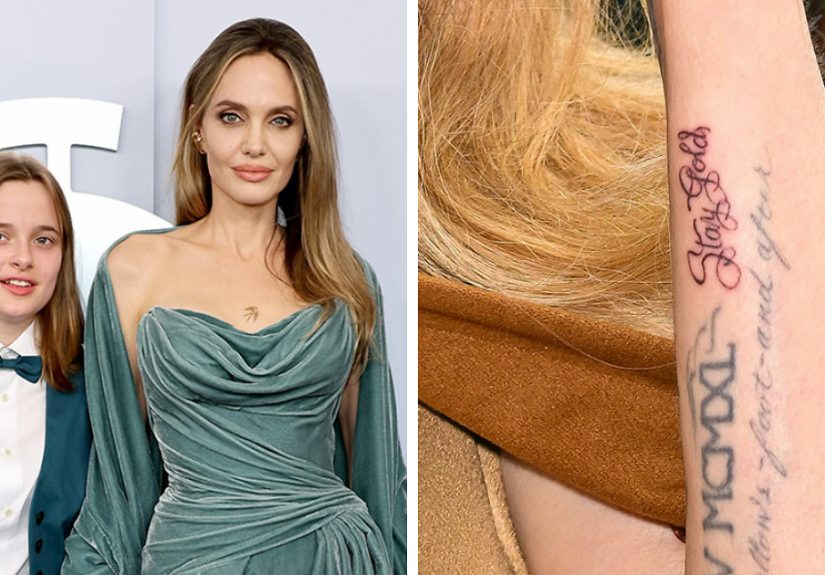
The drama started when Angelina Jolie revealed in an interview with CR Fashion Book that she and her
youngest daughter, 16-year-old Vivienne, got matching tattoos while working together on the Broadway production of
The Outsiders. Multiple outlets from E! News to ABC and People confirmed that the ink spells out the words
“Stay Gold,” a phrase closely tied to the story and to their time on the show together.
Jolie co-produced the musical adaptation, and Vivienne worked alongside her behind the scenes. The tattoo was
described as a personal souvenir of that shared experience, not a random impulse. For Angelina, who already has a
long history of deeply personal tattoos, this one is more like a scrapbook page etched into skin than a rebellious
stunt.
Angelina’s “Stay Gold” tattoo appears on her forearm, nestled among her other designs. The exact placement of
Vivienne’s version hasn’t been widely disclosed, which makes sense – she’s still a teenager, not a full-time
celebrity accessory. The point, for them, is the meaning, not the Instagram close-up.
What “Stay Gold” Actually Means
If your brain is screaming, “I know that line from somewhere,” you’re right. “Stay gold” comes from
The Outsiders, inspired by the Robert Frost poem “Nothing Gold Can Stay.” In the story, it’s a reminder to
hold onto your goodness, innocence, and sense of wonder in a world that keeps trying to grind them out of you.
For a mom and teen who spent months immersed in a show about fragile youth, loyalty, and loss, the phrase is
basically the emotional thesis statement. It’s less “reckless ink” and more “tiny permanent pep talk.” It also fits
Angelina’s long-time image: she’s always leaned into tattoos as a way to document milestones – kids’ birth
coordinates, tributes to causes, and symbols of transition.
From Sweet Gesture To Online Outrage
Of course, the internet saw “matching tattoo” and “teen daughter” and immediately went into full meltdown mode.
Coverage of the story highlighted not just the ink, but the wave of angry comments that followed. Some people called
it “gross,” others claimed Vivienne was being “branded,” and a few insisted Angelina was teaching her daughter
“bad values” instead of being a “proper role model.”
The loudest critics framed the tattoo as:
- Too permanent for a 16-year-old, even with parental consent.
- Too edgy for a mom who is supposedly meant to model “traditional” choices.
- Too controlling, with some implying the ink was more about Angelina than Vivienne.
That “Shame on her” line became shorthand for the whole backlash: a celebrity mother being scolded like a teenager
who broke curfew, because strangers didn’t like a decision she made with her own (legally old-enough-to-consent)
child.
The Other Side: Fans Who Think It’s Beautiful
Thankfully, the comments weren’t all pearl-clutching and finger-wagging. Plenty of fans and parents chimed in with
support, calling the matching tattoos “sweet,” “meaningful,” and “a cool mom move.” They pointed out that:
- Sixteen-year-olds in many places can get tattoos with parental permission.
- Vivienne didn’t just wake up one day and meet a tattoo needle; she worked on the show, loved it, and shared in the experience.
- The phrase “Stay Gold” is a gentle, positive message, not a skull, slogan, or questionable logo.
It also helps that Angelina is far from the only celebrity parent to turn ink into a family scrapbook. From
coordinates of their children’s birthplaces to tiny symbols representing each kid, stars like John Legend, Chrissy
Teigen, Jessica Alba, and others have proudly shown off tattoos honoring their children. Matching ink, especially
between parents and kids, is a well-established tradition in the celebrity universe – and increasingly in ordinary
families, too.
Angelina Jolie, Tattoos, And Life Under A Microscope
Part of why this story exploded is because Angelina Jolie isn’t just any parent. She’s a world-famous actor,
director, humanitarian, and a long-time lightning rod for public opinion. She’s been criticized for everything from
her love life to her parenting style to what she wears on the red carpet. Adding “got a tattoo with her teen” to
the list almost felt inevitable.
Jolie has more than twenty tattoos, many of them with political, spiritual, or family meanings. She’s spoken about
how tattoos help her mark phases of her life and assert her identity in an industry that constantly asks actors to
shape-shift into other people. For her, ink is not a random aesthetic; it’s a personal language.
That background is crucial. A woman who has always used her body as a canvas for her story deciding to share one
small chapter with her daughter is very on-brand. But the backlash shows that a lot of people are still deeply
uncomfortable when mothers – especially famous ones – do anything that looks “alternative,” even when it’s
thoughtful and intentional.
The Double Standard: Moms vs. Dads
Another piece of the outrage puzzle is the classic double standard. When dads get tattoos with their kids, the
reaction is often, “Aww, what a cool, involved father!” When moms do the same, there’s a higher chance of hearing,
“Is this appropriate? Is she being irresponsible? Is she trying too hard to be her kid’s friend?”
Angelina has been through this kind of scrutiny for years – from adoption choices to how she dresses her children.
The matching tattoo controversy fits neatly into that pattern: a mother judged not just on what she does, but on how
closely it conforms to someone else’s script for “good parenting.”
Is A Matching Tattoo With A Teen Really That Extreme?
Let’s zoom out from one famous family and talk about the bigger picture. In many U.S. states, minors can get
tattooed with parental consent. That doesn’t mean “anything goes,” but it does mean that the law recognizes
families as capable of making these decisions together.
A 16-year-old is old enough to:
- Work a job.
- Drive a car in many places.
- Make decisions about their appearance (hair color, clothing, piercings, etc.).
A tattoo is more permanent than a haircut, sure, but it’s not the wild outlier it used to be. Tattoos are now
completely mainstream – from nurses to teachers to engineers, ink is everywhere. Getting a tattoo that symbolizes
a major shared project with your mom is a far cry from getting a random logo at 2 a.m. on vacation.
The real question isn’t “Is a teen tattoo inherently terrible?” It’s “Was the decision thoughtful, informed, and
consensual?” From everything Angelina has shared, this was a planned, meaningful moment between two people who
clearly care deeply about each other and about the project that brought them closer.
Celebrity Parenting, Tattoos, And Recurring Outrage
It’s also worth noting that Angelina isn’t the only celebrity mom whose kid-related body art has kicked up a fuss.
Other stars have faced criticism for letting their children experiment with tattoos or tattoo-like looks – even when
the ink was temporary or part of a costume. Social media can turn a single photo into a parenting referendum in a
matter of hours.
These cycles of outrage tend to follow the same pattern:
- Parent and kid do something slightly unconventional with appearance.
- Photo goes viral.
- Comments fill up with “This is why society is doomed” and “They’re just expressing themselves, relax.”
- Everyone moves on to the next controversy in about three days.
The tattoos remain. The outrage does not.
What The “Stay Gold” Ink Says About Their Relationship
Strip away the noise, and the “Stay Gold” tattoo reads like a love letter between a mom and her daughter. It
connects:
- A specific moment in time – their work on The Outsiders Broadway musical.
- A shared passion – storytelling, theater, and art.
- A shared value – hanging onto the “gold” parts of themselves even in a harsh world.
For a teenager growing up in the glare of global celebrity and a family divorce playing out in headlines, that
message is powerful. If anything, it suggests a parent trying to anchor her teen in something tender and hopeful,
not push her into chaos.
Will Vivienne still love the tattoo when she’s 40? No one can say. But that uncertainty is built into every tattoo,
every hairstyle, every big life choice. That’s part of growing up – and part of parenting – whether you’re famous
or not.
What This Drama Really Reveals About Us
At its core, the backlash to Angelina Jolie’s matching tattoo isn’t just about ink. It’s about:
- How we police mothers more harshly than fathers.
- How uncomfortable some people still are with teens having bodily autonomy.
- How quickly social media turns nuance into hot takes.
A matching tattoo between a mom and her 16-year-old doesn’t automatically prove perfect parenting. But it also
doesn’t prove neglect, selfishness, or moral collapse. It’s one choice among thousands in a long, complicated parent–child
relationship – one that outsiders only ever see tiny fragments of.
The internet will continue to shout “Shame on her!” at celebrity mothers for everything from snacks to school
choices. Meanwhile, those mothers will keep doing what parents everywhere do: making imperfect decisions, hoping
they’re the right ones, and trying to build memories their kids will carry with them – sometimes literally – for
the rest of their lives.
500 Extra Words: Lived (And Tattooed) Experiences Around Parents & Teen Ink
Beyond celebrity drama, a lot of real-life families have stories that sound surprisingly similar to the Jolie
situation – just without the red carpet and global headlines. Matching tattoos between parents and teens are more
common than you might think, and the conversations around them reveal a lot about trust, communication, and what it
means to grow up together.
Why Some Families Choose Matching Tattoos
In many families, the idea starts with a specific moment: surviving a tough year, celebrating a graduation,
honoring a loved one who passed away, or marking a major shared project, like moving to a new country or starting a
business together. A tiny symbol – a date, a phrase, a small shape – becomes a visual reminder: “We went through
that side by side.”
Parents often describe matching tattoos with their teens as a kind of trust contract. It says, “I take you seriously
enough to make this choice with you, not just for you.” Teens, meanwhile, often say the tattoo makes them feel less
like “the kid in the house” and more like a full member of the family team. When done thoughtfully, it can be a
big vote of confidence in a young person’s judgment.
What Healthy Tattoo Conversations Look Like
Families that navigate this well tend to spend a lot more time talking than tattooing. Before anyone goes near a
needle, they usually cover questions like:
- Why this design? If the answer is “It looks cool,” they might slow down. If it’s tied to a shared story, they dig into that meaning.
- Why now? Is this about pressure, rebellion, or a genuine desire that’s been there for a while?
- Where on the body? Visible spots can affect work or school in some environments; more private placements may feel safer for a teen.
- What if you don’t like it later? They talk about regret, aging skin, and the reality that future them might feel differently.
Parents who are open but cautious often set guardrails: no tattoos that are hateful, offensive, or tied to a
romantic partner; no impulsive walk-in sessions; and ideally, waiting until a meaningful moment rather than turning
16 into an automatic “tattoo birthday.”
When It Goes Wrong (And How People Fix It)
Not every matching tattoo story is perfect. Some teens later admit they felt pressured to agree because they didn’t
want to disappoint a parent, or because they thought it would fix a rocky relationship. Others realize the design
doesn’t reflect who they are anymore.
The interesting thing is how families handle that regret. In the healthiest cases, parents don’t say, “Well, you
begged for it, live with it.” Instead, they frame it as part of learning: you made a big choice young, now you get
to decide what to do with the consequences – whether that’s laser removal, a cover-up, or simply reframing the
tattoo as “who I was then.”
That’s one of the subtle benefits of allowing teens to make a substantial but manageable permanent choice: they get
practice dealing with long-term outcomes while still having support. It’s a low-stakes version of what adulthood
requires constantly.
Thinking About A Matching Tattoo With Your Teen?
If this whole Angelina Jolie situation has you wondering whether a family tattoo is sweet or scary, here are a few
practical guidelines many parents use:
- Start with conversations, not designs. If you can’t talk openly about fears, values, and boundaries, you’re not ready for shared ink.
- Focus on meaning over aesthetics. A tiny word or simple symbol you both truly connect with ages far better than a trendy image.
- Respect “no.” If either of you hesitates, that’s your answer – at least for now.
- Choose a reputable studio. Hygienic, professional artists are non-negotiable, especially for younger clients.
- Accept that it might look different later. That’s not a failure; it’s a timeline. What mattered at 16 can still be valid even if you evolve beyond it.
In the end, a matching tattoo between a parent and teen is neither automatically a red flag nor automatically proof
of an amazing relationship. It’s a tool – a symbol – that can reflect closeness, pressure, healing, or anything in
between. For Angelina Jolie and her daughter, “Stay Gold” is their chosen reminder of a very specific moment they
lived side by side. The internet might forget the headlines next week, but for them, that line will still be there,
quietly glowing under the skin.
Maybe the real question isn’t whether we approve of their ink, but whether we can accept that not every family
story was written for us to judge.