Table of Contents >> Show >> Hide
- What Is a Tarantula Hawk, Exactly?
- Identification: How to Tell a Tarantula Hawk from Other Big Wasps
- Where Tarantula Hawks Live (and Why You’re Seeing One)
- Are Tarantula Hawks Dangerous?
- The Sting: What It’s Like and What to Do
- Removal: Do You Actually Need to Get Rid of Tarantula Hawks?
- Behavior Facts That Explain Why They Act So Intense
- FAQ: Fast Answers to Common Tarantula Hawk Questions
- What to Do If You See One: A Calm, Practical Game Plan
- Real-World Encounters: Experiences People Commonly Report (Extra Detail)
- Conclusion
If you’ve ever seen a huge, shiny-black “wasp” with blazing orange wings cruising low over a driveway like it pays rent there,
congratulations: you’ve probably met a tarantula hawk. Despite the dramatic name, it’s not a tiny bird with anger issuesit’s a
spider wasp (most commonly in the genera Pepsis and Hemipepsis) that specializes in hunting tarantulas.
And yes, the sting has a reputation… but the insect itself is usually more “don’t-touch-me” than “come-at-me.”
This guide breaks down how to identify tarantula hawks, what to do if you’re stung, and when “removal” is actually needed
(spoiler: often it isn’t). We’ll keep it practical, science-based, and just humorous enough to make you feel brave again.
What Is a Tarantula Hawk, Exactly?
Tarantula hawks are large spider wasps in the family Pompilidae. The adults sip nectar from flowers, while females hunt
large spidersespecially tarantulasto provide food for their developing young. They’re most commonly associated with the deserts
and dry regions of the American Southwest, but you may also spot relatives or similar spider wasps in other warm areas.
A key detail that calms nerves fast: tarantula hawks are typically solitary. They don’t form the kind of big, defensive colonies you
might associate with yellowjackets. So if you see one, you’re not automatically standing on the welcome mat of a thousand angry cousins.
Identification: How to Tell a Tarantula Hawk from Other Big Wasps
The quick “ID checklist”
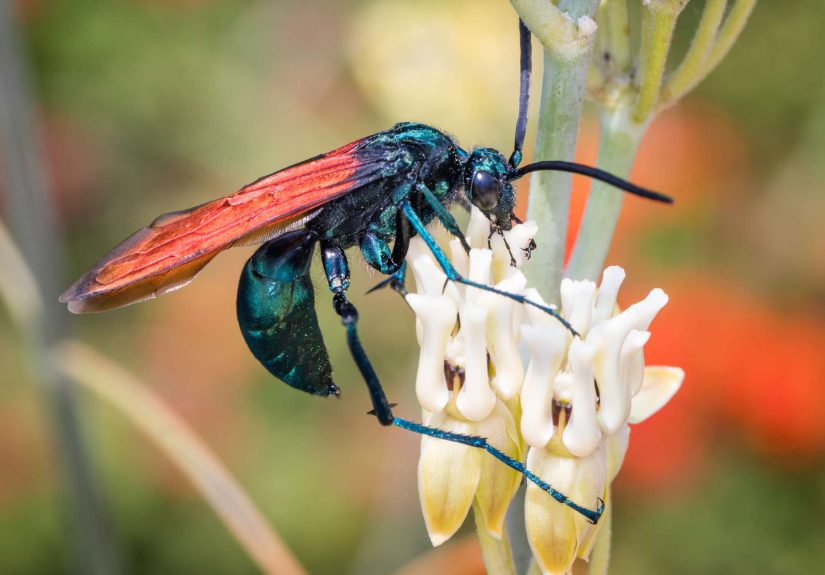
- Size: Often around 1.5–2 inches long, sometimes larger depending on species and region.
- Color: Dark, usually blue-black and iridescent body (it can look like oil slick shimmer in the sun).
- Wings: Commonly bright orange/rusty wings (some species can have darker wings).
- Legs: Long, spindly legs that look built for sprinting across hot ground.
- Overall vibe: A “loud warning outfit” that says: admire from a respectful distance.
Male vs. female: the sting situation
If you only remember one thing, make it this: females sting; males don’t. Males can look intimidating, but they lack
a stinger. In many tarantula hawks, females also tend to hold their antennae in a more curved or “curly” posture compared with males,
which often appear straighter.
Look-alikes that cause false alarms
Big flying insects love confusing humansprobably as a hobby. Here are common mix-ups:
- Cicada killers: Also large, but usually patterned (not sleek black) and often seen around lawns and trees.
- Mud daubers: Slender “thread-waist” look, often with narrower bodies and different wing coloration.
- Other spider wasps: Some have smoky or partially orange-tipped wings and may hunt different spiders.
- Wasp mimics (flies): Certain large flies can mimic wasps surprisingly wellright down to the flight style.
Practical tip: if it’s glossy dark with vivid orange wings and seems to “patrol” low over the ground, tarantula hawk is a strong guess.
If it’s patterned like a sports jersey or hovering around tree branches calling for a cicada buffet, it might be something else.
Where Tarantula Hawks Live (and Why You’re Seeing One)
In the U.S., tarantula hawks are most famous in the Southwestthink Arizona, New Mexico, parts of California, Nevada, Utah, and Texaswhere
tarantulas and large spiders are more common. They also show up in other dry, warm regions and can appear in places like Colorado depending on
species and season.
Common places you’ll spot them
- Desert landscapes: Washes, trails, scrub, rocky edges, and open sandy soil.
- Neighborhood edges: Gravel yards, desert landscaping, and weedy borders with flowers.
- Gardens: Especially where nectar-rich blooms are available.
Why they hang around yards
Tarantula hawks usually show up for two reasons:
(1) nectar (the adult “fuel”) and (2) spiders (the future baby-food plan). A yard with flowering plants,
irrigated corners, or lots of spider activity can look like a very good neighborhood to them.
Are Tarantula Hawks Dangerous?
They’re “dangerous” in the same way a cactus is dangerous: if you grab it, you will have a bad time. But if you don’t grab it, it usually
minds its own business.
Tarantula hawk females can deliver an extremely painful sting, but they’re generally not eager to do so. Most stings happen when someone
accidentally steps on one barefoot, traps it in clothing, or tries to handle it. In other words: the wasp is not out there plotting your downfall;
it’s out there plotting a spider’s downfall.
The Sting: What It’s Like and What to Do
How painful is it?
Tarantula hawk stings are widely described as intensely painful. That reputation is real. The good news is that severe pain doesn’t automatically mean
“medically dangerous.” The bigger risk is an allergic reaction, which can happen with many stinging insects.
Typical symptoms
- Immediate burning or intense pain at the sting site
- Redness and swelling around the area
- Itching later as the area calms down
- Localized warmth and tenderness
First aid steps (simple and safe)
- Move away to avoid additional stings and to calm the situation.
- Wash the area with soap and water.
- Cold compress (ice pack wrapped in cloth) for 10–20 minutes; repeat as needed.
- Elevate the limb if the sting is on an arm or leg to reduce swelling.
- Consider OTC symptom relief if appropriate for you (for example, hydrocortisone cream or calamine for itch;
a pain reliever such as ibuprofen or acetaminophen if you can take them safely).
Note: Unlike honeybees, most wasps don’t leave a stinger behind. So don’t panic-search for a stinger like it’s a villainous splinter
you may not find one.
When to seek urgent medical care
Call emergency services or seek urgent help if any of these happen after a sting:
- Difficulty breathing, wheezing, throat tightness
- Swelling of the face, lips, tongue, or throat
- Widespread hives or rapidly spreading rash
- Dizziness, fainting, confusion, or severe weakness
- Multiple stings, or a sting in/near the mouth or eye
If you’ve had a severe allergic reaction to insect stings before, treat any new sting as “serious until proven otherwise.”
It’s always better to be cautious than to be impressively stubborn.
Removal: Do You Actually Need to Get Rid of Tarantula Hawks?
In many cases, no. Tarantula hawks are usually temporary visitors. They’re also beneficial predators in ecosystems
(they help keep large spider populations in check), and they don’t typically create the kind of aggressive nest-defense problems that social
wasps do.
That said, “leave it alone” is easier advice when the wasp isn’t patrolling the exact path between your back door and your trash can.
So here’s a sensible, safety-first approach.
When removal might be justified
- You frequently see them in a high-traffic area where barefoot kids/pets run
- A wasp repeatedly enters a garage, shed, or enclosed patio
- Someone in the household has a known severe insect-sting allergy
- You suspect a burrow/nesting site is right next to a doorway or play area
What NOT to do
- Don’t swat or grab. Trapping and crushing is a top way people get stung.
- Don’t use gasoline or improvised chemicals. That’s dangerous for you, your home, and the environment.
- Don’t “test bravery.” This is not a sport. No trophies are awarded.
Safe “removal” for indoors (non-contact approach)
- Keep distance and keep pets/kids out of the room.
- Open an exterior door or window to give it an exit route.
- Turn off indoor lights and, if needed, turn on an outside light so it navigates outward.
- If it won’t leave and you’re concerned, call a licensed pest professionalespecially if someone is allergic.
Prevention: make your yard less attractive (without turning it into a moonscape)
- Wear shoes outdoors, especially on gravel, patios, and near flowering plants.
- Use gloves when gardeningparticularly around ground holes or dense plants.
- Reduce attractants near doors: keep trash sealed, pick up fallen fruit, and avoid leaving pet food outside.
- Maintain screens on windows/doors and seal obvious gaps where insects can wander in.
- Limit “perfect burrow spots” right next to entryways by keeping soil compacted and borders tidy.
One more reality check: if you live where tarantula hawks live, you may see them occasionally no matter what you do. Prevention is about reducing
surprise encounters in busy areasnot achieving total wasp invisibility (that’s not a feature available in nature).
Behavior Facts That Explain Why They Act So Intense
They’re solo hunters
Female tarantula hawks search the ground for tarantulas and other large spiders. When they find one, they use a sting to immobilize it and then
move it to a protected spot for their egg and developing larva. This sounds like a horror movie for spiders (it is), but it also explains why the wasp
often seems focused on the ground instead of on you.
Adults are flower visitors
When they’re not hunting, adult tarantula hawks commonly visit flowers for nectar. That’s why you might see one drifting among blooms like a goth fairy
with orange wings.
They’re not looking for a fight
Their bright colors are basically a walking billboard that says, “Please don’t eat me.” Many animals learn quickly that this is not a fun snack.
For humans, the message translates to: admire, photograph, and keep your hands to yourself.
FAQ: Fast Answers to Common Tarantula Hawk Questions
Do tarantula hawks build big nests?
Not usually. They’re solitary and use burrows or protected ground chambers for developing young rather than building large paper nests.
Will a tarantula hawk chase me?
Typically no. If one seems to “follow,” it may be traveling the same direction, patrolling for mates, or simply using the same open corridor of air.
Give it space and it generally moves on.
Can they sting multiple times?
Like many wasps, a female can sting more than once if she feels threatened. That’s why avoiding contact is the golden rule.
Are they common in New Mexico?
They’re well known therePepsis grossa is even recognized as the state insect of New Mexico, which is a very bold choice for a state mascot.
(It’s basically saying, “Welcome! Don’t touch the wildlife.”)
What to Do If You See One: A Calm, Practical Game Plan
- Step 1: Pause. Confirm what you’re looking at (big, dark, orange-winged, long-legged = likely).
- Step 2: Give it space. A few feet is good; more is better.
- Step 3: Keep barefoot traffic away from the area for the day.
- Step 4: If it’s around flowers near your entry, use a different door temporarily and consider trimming/tidying later.
- Step 5: If you have repeated high-risk encounters, call a licensed pest pro for site-specific advice.
Real-World Encounters: Experiences People Commonly Report (Extra Detail)
If you ask people who live in the Southwest about tarantula hawks, you’ll often get the same story structure: “I saw something huge,
I assumed it was angry, and then it mostly ignored me while doing its own weirdly important errands.”
One common experience is spotting a tarantula hawk in the late morning or afternoon, gliding low over gravel or bare soil like it’s conducting
a ground inspection. People describe it as “patrolling” because it may fly a few feet, land, walk, then fly againespecially near walls, rock borders,
or the edges of patios. That’s not it scouting your ankles; it’s often searching for spider habitat or navigating toward nectar sources.
The safest response is boring (and therefore excellent): stop, step back, and let it pass.
Gardeners often notice tarantula hawks at flowerssometimes milkweed, sometimes native blooms, sometimes whatever is thriving despite the heat.
The wasp may look intense up close, but the behavior at flowers is usually calm: sipping nectar and moving on. A very practical “experience-based” tip
people share is to avoid leaning your face right into flowering shrubs if you’ve already seen a tarantula hawk visiting them. Not because it wants to
sting you, but because surprise close-range encounters are how humans accidentally start drama.
Another scenario people talk about is the “driveway moment”: you’re carrying groceries, focused on not dropping the eggs, and a tarantula hawk cruises
by at knee height. The brain instantly screams GIANT WASP and the body wants to do interpretive dance. The helpful trick here is to freeze for a second
and track where it is, instead of flailing. Sudden swats or frantic movements are more likely to cause an accidental collision or trap the insect against
clothingtwo classic ways stings happen.
In desert towns, people also report seeing tarantula hawks after seasonal weather shiftsespecially when flowers pop or insects become more active.
You might notice a short “window” of sightings in a particular spot and then nothing for weeks. That pattern fits a solitary insect that’s moving through,
feeding, mating, and hunting as conditions allow. For homeowners, the best takeaway is that you don’t usually need a big “war plan.” You need a small
“don’t step on it” plan: shoes outside, gloves for gardening, and keeping entryways screened and tidy.
Finally, there’s the unforgettable experience some people report witnessing from a distance: a tarantula hawk interacting with a large spider.
Even if you never see that in real life (many people don’t), it explains the wasp’s laser focus on the ground and why it may be present in areas where
tarantulas are occasionally found. If you do witness something like that, the safest “experience-based” advice is simple: treat it like wildlife viewing.
Watch from far away, don’t intervene, and definitely don’t try to “help” by moving either animal. The wasp’s defense is built-in, and the spider is not a
safe-handling project either.
The most useful pattern across these real-world reports is reassuring: tarantula hawks look intimidating, but they’re usually not aggressive toward people.
Most negative encounters come from surprise contactbarefoot steps, accidental trapping, or attempted handling. So the best “lived wisdom” is also the simplest:
respect the space, reduce surprises, and let the orange-winged tank handle its spider business elsewhere.
Conclusion
Tarantula hawks are easy to recognize once you know the telltale look: an iridescent dark body, vivid orange wings, and long legs built for desert life.
Their sting is famously painful, but they’re typically docile unless provoked or accidentally trapped. Most of the time, “removal” means reducing risky
close encounterswear shoes, keep entry points screened, tidy up attractants near doors, and give them space. When safety concerns are high (allergies,
repeated indoor appearances, high-traffic areas), a licensed pest professional is the smartest and safest option.