Table of Contents >> Show >> Hide
Rice is amazing. It’s also a creature of habit. One day you’re making stir-fry, the next day you’re making… stir-fry again… and rice is just there like,
“Hi, we meet every night at 7.” If you’re craving variety, trying to add more fiber, cutting carbs, or you simply ran out of rice and refuse to put on pants
and go to the store (valid), you’ve got options.
The good news: plenty of rice alternatives can slide into your bowl, soak up sauce, and make your dinner feel brand new. Some are whole grains with a hearty chew,
some are quick-cooking pantry heroes, and some are veggies doing an Oscar-worthy impression of rice.
Why Swap Rice at All?
Swapping rice isn’t about villainizing rice. It’s about expanding your “base layer” choices so your meals can match your goals (and your mood).
Depending on what you choose, rice substitutes can help you:
- Boost fiber and keep you fuller longer (hello, chewy whole grains).
- Add protein without changing the vibe of your meal (quinoa, we see you).
- Lower carbs while keeping your plate satisfying (riced veggies for the win).
- Change texture so the same sauce tastes different (a little chew goes a long way).
- Speed things up on busy nights (couscous is basically the weeknight intern who over-delivers).
How to Pick the Best Rice Alternative
Think of rice as a “supporting actor.” Your swap needs to play nicely with the rest of the cast. Before you choose, ask:
- Do I want fluffy, chewy, or creamy? (Fluffy: couscous/quinoa; Chewy: farro/barley; Creamy: polenta.)
- Do I need gluten-free? (Quinoa and millet are naturally gluten-free; farro, barley, bulgur, and couscous are wheat-based.)
- Am I aiming low-carb? (Cauliflower rice is the obvious MVP.)
- What’s the job? Stir-fry base, curry sponge, salad grain, “risotto” moment, meal prep hero?
The 8 Delicious Rice Alternatives
1) Quinoa
Quinoa is technically a seed, but it behaves like a grain in all the ways you care about: fluffy, scoopable, and happy to absorb flavor.
It’s a strong rice alternative when you want a little more protein and a slightly nutty taste without changing your meal’s personality.
Best for: burrito bowls, grain bowls, pilafs, salads, stuffed peppers, “anything with sauce.”
Easy swap tip: Rinse it first (quinoa can have a natural coating that tastes bitter). Cook until the little “tails” spiral out, then let it sit covered a few minutes and fluff.
If your quinoa is turning out wet, use a touch less liquid next time; if it’s crunchy, give it a splash and a few more minutes.
2) Cauliflower Rice
Cauliflower rice is the undercover veggie that shows up in your bowl wearing a rice costume. It’s a low-carb rice substitute that still delivers that “base” feeling,
especially when you season it like you mean it.
Best for: fried “rice,” curry bowls, stir-fries, taco bowls, meal prep lunches where you want more veggies.
Easy swap tip: The #1 complaint is sogginess. The fix is heat and space: use a wide pan, medium-high heat, and don’t overcrowd.
You’re not boiling caulifloweryou’re driving off moisture. Finish with salt, citrus, herbs, or a drizzle of sesame oil so it tastes like a side dish, not a compromise.
3) Farro
Farro is the chewy, nutty whole-grain cousin who makes every bowl feel “restaurant.”
It’s especially good when you want a hearty texturethink “grain bowl that actually keeps you full,” not “sad desk salad.”
(Note: farro contains gluten, since it’s a type of wheat.)
Best for: Mediterranean bowls, “risotto-style” farro, soups, salads, meal prep.
Easy swap tip: Farro comes in different levels of processing (pearled, semi-pearled, whole), which changes cooking time.
If you’re new to it, pearled farro is the easiest weeknight option. Cook it until tender but still pleasantly chewy, then toss with olive oil and a pinch of salt to keep it from clumping.
4) Barley
Barley is comfort food energy in grain form. It’s pleasantly chewy and famously great in soups, but it also works as a rice replacement in bowls and pilafs.
It’s also known for beta-glucan, a type of soluble fiber associated with heart-health benefits. (Barley contains gluten.)
Best for: soups and stews, mushroom “barley risotto,” hearty bowls, veggie pilafs.
Easy swap tip: Use it when you want your base to have backbone. If you’re meal prepping, barley holds up well in the fridge without turning to mush,
which is more than we can say for certain sad leftovers we’ve all met.
5) Bulgur
Bulgur is what happens when wheat gets practical. It’s parboiled, cracked, and quick to cookmeaning it’s basically built for weeknights.
The texture is light and slightly chewy, making it a smart substitute for rice when you want something fast but still “grainy” in a good way.
(Bulgur contains gluten.)
Best for: quick grain bowls, tabbouleh-style salads, stuffed vegetables, skillet meals.
Easy swap tip: Fine bulgur can be rehydrated quickly, while coarser bulgur takes longerso check the package.
Try cooking it in broth with a little garlic and lemon zest for instant “why does this taste so good?” vibes.
6) Whole-Wheat Couscous
Couscous is often mistaken for a grain, but it’s actually a tiny pasta made from semolina wheat.
Translation: it cooks fast and loves sauce. Whole-wheat couscous adds a nuttier flavor and more fiber than the regular version.
(Not gluten-free.)
Best for: last-minute sides, saucy mains, sheet-pan dinners, quick meal prep.
Easy swap tip: Couscous is the easiest way to replace rice when you have 10 minutes, not 45.
Fluff it with a fork, then fold in herbs, toasted nuts, or chopped veggies so it looks like you tried (even if you didn’t).
7) Millet
Millet is mild, slightly sweet, and naturally gluten-free. If you’ve ever wanted a neutral base that won’t fight your sauce, millet is your friend.
It can turn out fluffy like riceor creamy like porridgedepending on how much liquid you use and how long you cook it.
Best for: grain bowls, simple sides, breakfast bowls, curry pairings.
Easy swap tip: Toast millet in a dry pan for a few minutes before simmering. That tiny step boosts flavor and helps it taste less “plain,” more “subtly nutty and fancy.”
If your millet clumps, fluff it and give it a minute off-heatgrains love a little alone time.
8) Polenta
Polenta (cornmeal cooked into a creamy base) is not a “grain-for-grain” rice cloneand that’s the point.
When you want your meal to feel cozy and spoonable, polenta steps in like a warm blanket you can eat.
It’s naturally gluten-free as long as your cornmeal/polenta is certified gluten-free (to avoid cross-contact).
Best for: saucy braises, roasted veggies, shrimp, mushrooms, anything that needs a creamy base.
Easy swap tip: Go creamy under stews and saucy mains, or chill leftover polenta until firm, slice it, and crisp it in a pan.
Suddenly, your “rice alternative” is also your “crispy side dish that disappears first.”
Quick Pairing Ideas (So You Can Start Tonight)
- Teriyaki stir-fry: cauliflower rice or quinoa + extra scallions and sesame seeds.
- Chili or stew: barley or polenta as the base (barley in the pot, polenta in the bowl).
- Mediterranean bowls: farro or bulgur + cucumber, tomato, feta, lemony dressing.
- “I forgot to meal prep” lunch: whole-wheat couscous + rotisserie chicken + bagged salad kit.
- Curries: millet or cauliflower rice if you want lighter; farro if you want hearty.
Common Swap Mistakes (And How to Avoid Them)
- Under-seasoning: Rice is a blank canvas, but it’s not flavorless by defaultsalt matters.
Same goes for swaps. Season the base, not just the topping. - Expecting identical texture: If you want “sticky rice behavior,” pick something that can clump (like couscous or a creamy polenta base),
not a bouncy whole grain that loves being individual. - Overcooking riced veggies: Cauliflower rice turns watery if you cook it too long.
High heat, short time, then stop messing with it. - Ignoring grain type: Farro and bulgur vary by processing and grind.
If you’re not sure, taste as you go instead of trusting the clock with your whole heart.
Conclusion
Rice will always have a place at the tablebut it doesn’t need to be the only base in your rotation.
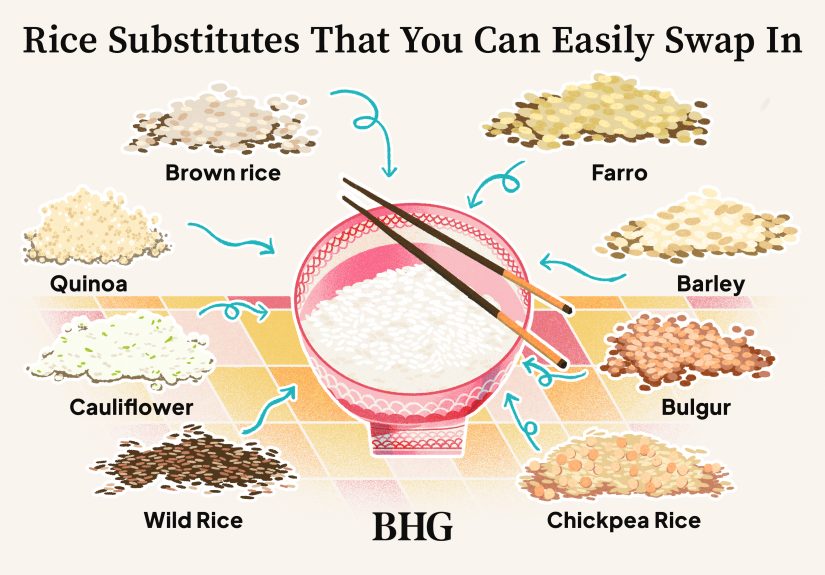
With quinoa, cauliflower rice, farro, barley, bulgur, whole-wheat couscous, millet, and polenta, you can match the texture and nutrition you want,
keep meals interesting, and still enjoy that glorious “pile of something delicious under the saucy thing” feeling.
Extra: Real-World Kitchen Experiences With Rice Swaps (About )
If you’ve ever tried a rice alternative and thought, “Well… that was technically edible,” you’re not alone. Most swap disappointments come down to two things:
expectations and technique. The good news is you don’t need chef skillsyou need a couple of small adjustments that real home cooks learn the hard way.
First up: cauliflower rice. People often treat it like rice and cook it like rice, which is exactly how you get a soggy situation.
The most successful cauliflower-rice dinners usually come from one simple mindset shift: you’re sautéing moisture out, not simmering moisture in.
A wide pan, medium-high heat, and enough breathing room for steam to escape makes a huge difference. Many home cooks also find that adding flavor at the endlike lime,
cilantro, garlic, chili crisp, or a tiny pat of butterturns it from “diet food” into “I would eat this on purpose.”
Quinoa has its own learning curve, but it’s friendly. The most common “why does this taste weird?” moment is skipping the rinse.
Once rinsed, quinoa tends to win people over because it behaves like rice in bowls and meal prep. A lot of folks end up cooking a double batch on purpose,
because cold quinoa makes a great next-day salad: toss with lemon, olive oil, chopped veggies, and whatever protein you have. It’s one of those rare leftovers that feels
like a plan, not a regret.
Then there’s the “chew club”: farro and barley. The first time someone uses farro as a rice substitute, the reaction is usually,
“Ohthis feels like a real meal.” That chew gives your bowl structure, especially if your toppings are soft (braised meat, roasted veggies, beans).
Farro and barley also tend to hold up well over a few days, which is why meal-preppers love them. If you’ve ever opened the fridge to sad, mushy leftovers,
these grains are a refreshing change of character.
Bulgur and whole-wheat couscous are the weeknight rescue squad. People who keep them in the pantry usually have one story in common:
they were starving, had no time, and couscous/bulgur saved dinner in under 15 minutes. Couscous especially becomes a go-to when you want something that absorbs sauce fast.
The “pro move” many home cooks adopt is stirring in a spoonful of pesto, a squeeze of lemon, or a handful of herbs right after fluffinginstant flavor without extra work.
Finally, millet and polenta are the underrated comfort picks. Millet is often a sleeper hit because it’s neutralgreat when your curry or stir-fry is already bold.
Polenta is the opposite: it’s a vibe. People usually fall for polenta when they realize it can be creamy under a stew or chilled and crisped into golden slices the next day.
That leftover transformation is the kind of kitchen win that makes you feel like you have your life togethereven if your laundry says otherwise.
Bottom line: the best rice alternative is the one that fits your meal, your schedule, and your taste buds. Try one swap at a time, season your base,
and give it two attempts before you decide it’s “not for you.” Your future dinners will thank you.