Table of Contents >> Show >> Hide
- Before Anything Else: Do the 60-Second Safety Check
- Way 1: Rule Out “Normal” Smells and Dangerous Laundry Loads
- Way 2: Attack Lint Where It Actually Hides (Not Just the Lint Trap)
- Way 3: Restore Airflow by Inspecting and Cleaning the Dryer Vent System
- Way 4: Check for Overheating, Friction, and Failing Parts (Belt, Motor, Element, Wiring)
- When to Stop DIY and Call a Professional Immediately
- Conclusion: A Burning Smell Is a ClueFollow It Methodically
- Extra Field Notes: 5 Real-World “Burning Smell” Scenarios (and What They Teach You)
A dryer that smells like it is burning is the household equivalent of your car making a new noise:
it instantly turns you into a detective, a mechanic, and a slightly nervous person who keeps sniffing the air
like a bloodhound in pajama pants. Good news: the “burning smell from dryer” problem is often fixable.
Better news: you can troubleshoot it safely in a way that protects your home, your clothes, and your sanity.
This guide synthesizes safety recommendations and real-world troubleshooting patterns shared by U.S. fire-safety organizations,
consumer experts, and experienced appliance repair pros. We’ll keep it practical, a little funny, and very focused on what matters:
airflow, heat, friction, and when to stop DIY and call a pro.
Before Anything Else: Do the 60-Second Safety Check
If your dryer smells like burning, treat it like a potential fire hazard until proven otherwise. Most of the time it’s lint or
overheating, but “most of the time” is not a safety plan.
- Stop the cycle. Don’t “just finish this load.” Burning smells don’t need closure.
- Turn the dryer off and unplug it. If it’s a gas dryer, also turn off the gas supply valve.
- Look and listen. Any smoke, sparking, glowing, or loud buzzing? Keep the door closed, move people away, and call emergency services.
- Let it cool. Give it 10–15 minutes before touching internal parts. Burnt-lint perfume is one thing; actual burns are another.
Once you’ve confirmed there’s no active smoke or flame, you can move into troubleshooting. The four methods below are ordered
from most common (and easiest) to less common (and more “maybe call a technician”).
Way 1: Rule Out “Normal” Smells and Dangerous Laundry Loads
New dryer smell vs. real trouble
If the dryer is brand newor you recently replaced a heating element or installed a new ventsome temporary odor can happen as
manufacturing residues burn off. That smell should be mild, fade quickly, and not come with overheating, smoke, or clothes that feel hotter than usual.
If the odor is sharp, heavy, or worsening each cycle, skip the “it’s probably fine” optimism and keep troubleshooting.
Check the load: chemicals, oils, and “mystery rags”
Some of the scariest dryer burning-smell calls are caused by what’s in the drum, not the machine. Items that have touched
flammable substances (gasoline, paint thinner, certain solvents) can ignite. Even “everyday” oils can be risky: oily shop rags,
cooking grease on towels, or cloths used with waxes or polishes.
- If you washed oily or solvent-exposed items: air-dry them first, then wash again if needed before using the dryer.
- If the smell is coming from the clothes: remove the load, spread items out to cool, and do not re-run immediately.
- If you recently used a lot of dryer sheets: residue on the lint screen can reduce airflow (we’ll address this in Way 2).
Quick “sniff test” decision point
If the odor seems load-specific (only happens with certain towels, rags, or athletic gear), you may have found the culprit.
If the odor happens no matter what you dryor you also notice long dry times or excessive heatmove on to airflow and lint.
Way 2: Attack Lint Where It Actually Hides (Not Just the Lint Trap)
Yes, you already clean the lint screen. Gold star. But lint is crafty. It escapes screens, clings to hidden ledges,
and builds up in places you never seeuntil your dryer starts smelling like a campfire you didn’t plan.
Step 1: Clean the lint screen the right way
Pull the lint screen out and remove lint after every load. Then do a deeper clean:
- Wash the screen with warm water and a little dish soap, especially if you use dryer sheets (they can leave a film).
- Rinse and dry fully. A wet screen catches lint and can worsen airflow.
- Hold it to light. If light doesn’t pass easily through the mesh, it’s not really clean yet.
Step 2: Vacuum the lint screen housing
With the dryer unplugged, use a vacuum hose attachment to clean inside the lint trap chute/housing. If you have a long, flexible
lint brush, even bettergently loosen compacted lint, then vacuum again.
Step 3: Check for lint buildup around the dryer and underneath
Lint behind and beneath the dryer is more than a cleanliness issueit’s fuel. Pull the dryer out carefully and vacuum:
- the floor area behind/under the unit
- the back panel area (outside surfaces)
- around the vent connection point
What success looks like: improved airflow, shorter drying times, and the burning smell either disappears or becomes noticeably weaker.
If the smell persists, the next suspect is the vent line itself.
Way 3: Restore Airflow by Inspecting and Cleaning the Dryer Vent System
Restricted airflow is the #1 reason a dryer overheats. When hot, moist air can’t exit, temperatures climb, lint accumulates faster,
and components work harder. That’s when “dryer smells like burning” turns from annoying to dangerous.
Start outside: the exterior vent hood
Turn the dryer on for a minute (only if it’s safe, supervised, and you’ve already checked for active burning). Go outside and look at the vent hood:
- Is the flap opening? If it barely moves, airflow is weak.
- Is lint packed in the grille? Remove it carefully.
- Any bird nest or debris? It happens more than people want to admit.
Inspect the duct behind the dryer
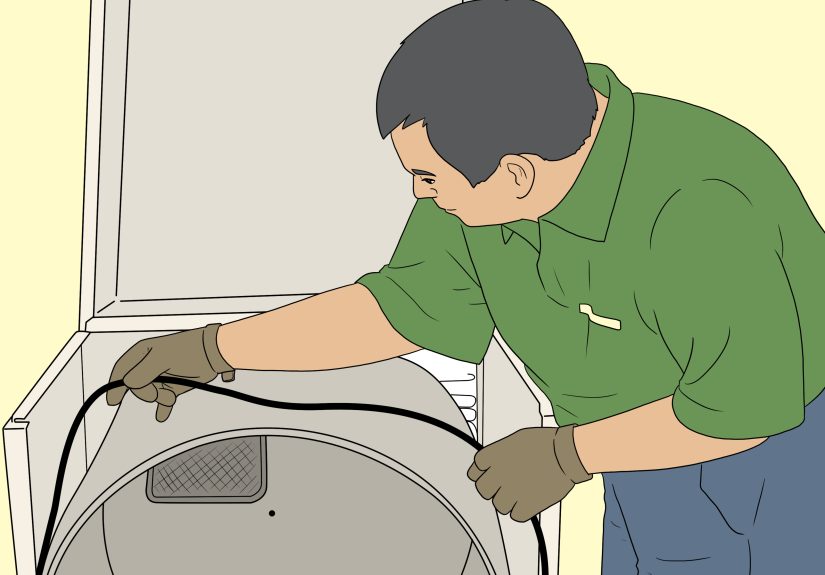
Unplug the dryer. Pull it forward. Look at the vent duct:
- Crushed or kinked hose: common and very fixablereposition the dryer and replace damaged ducting.
- Material matters: smooth, rigid or semi-rigid metal ducts generally vent better and trap less lint than flimsy accordion-style options.
- Loose connections: vibration can shake joints apart over time. Re-secure with proper clamps/foil tape rated for ducts (not standard cloth duct tape).
Deep clean the vent run (the whole path to the outside)
If you have long drying times, a hot dryer exterior, or recurring burning odor, assume lint buildup in the vent line.
You can use a dryer vent cleaning kit (brushes designed for ducts) and a vacuum to remove lint. If your vent run is long,
has multiple turns, goes up through a wall, or vents through a roof, professional dryer vent cleaning is often the safer choice.
Signs you should stop and schedule professional vent service
- your vent route is long/complex or hard to access
- you see heavy lint accumulation quickly after cleaning
- the smell returns within a few cycles
- clothes still take multiple cycles to dry
What success looks like: strong airflow at the exterior vent, normal drying times, less heat buildup, and no burning smell.
If airflow is now solid but the odor remains, it’s time to check for friction or failing parts.
Way 4: Check for Overheating, Friction, and Failing Parts (Belt, Motor, Element, Wiring)
If lint and venting aren’t the issue, the burning odor may be coming from a part that’s overheating or rubbing. This often produces
a more specific smell: hot rubber (belt), hot plastic (blower wheel obstruction), or “electrical” (wiring/terminal issues).
Clue #1: Burning rubber smell (belt or pulley friction)
A worn drive belt can slip, glaze, or fraycreating a burning-rubber odor. You may also hear squealing or thumping.
Other friction points include the idler pulley or drum rollers. If the drum doesn’t turn smoothly by hand (with the unit unplugged),
something is dragging.
DIY-friendly check: If you’re comfortable removing the front/back access panel (varies by model), inspect the belt for cracks,
fraying, or shiny glazed spots. If you see damage, replace the belt and inspect the idler pulley and rollers for free movement.
Clue #2: Hot, dusty smell + weak airflow (blower wheel or internal blockage)
Even with a clean vent, a partially obstructed blower wheel can reduce airflow and cause overheating. Small items can sneak into places
they shouldn’tthink coins, hairpins, a rogue sock, or that tiny baby shoe that vanished in 2023.
If you hear unusual rattling or humming, stop using the dryer and consider a technicianespecially if you suspect something is lodged near the blower housing.
Clue #3: Sharp electrical smell (wiring, terminals, or heating element issues)
An electrical burning smell is not a “let’s see what happens” situation. Loose power-cord connections, failing terminals, damaged wiring,
or a heating element touching metal can cause overheating and scorch marks.
- If you see scorch marks near the outlet, cord, terminal block, or inside the cabinet: stop and call a pro.
- If the breaker trips or lights flicker when the dryer runs: stop and have it inspected.
- If you have a gas dryer: also watch for unusual burner behavior and any gas odorif you smell gas, shut off the gas and ventilate the area immediately.
Clue #4: Overheating symptoms (even if the smell isn’t constant)
Overheating can point to airflow problems, but it can also indicate a thermostat, thermal fuse, or control issue.
Warning signs include:
- dryer exterior is extremely hot
- clothes feel scorching at end of cycle
- dryer shuts off mid-cycle repeatedly
- burning smell appears late in the cycle
Bottom line: If you’ve cleaned lint and venting thoroughly and the dryer still smells like burning, internal components are likely involved.
At that point, calling an appliance technician is often the fastestand safestway to prevent repeat overheating.
When to Stop DIY and Call a Professional Immediately
Troubleshooting a dryer burning smell is a great DIY project right up until it’s not. Call a professional (or emergency services when appropriate) if:
- you see smoke, sparking, or glowing
- the smell is distinctly electrical or chemical and doesn’t fade quickly
- the dryer trips the breaker, blows fuses, or won’t stop overheating
- the vent route is long/hidden and you can’t clean it end-to-end
- you find scorched lint, melted plastic, or damaged wiring
Safety isn’t being dramatic. Safety is being able to do laundry tomorrow.
Conclusion: A Burning Smell Is a ClueFollow It Methodically
Most burning dryer smells come down to airflow and lint: a clogged lint screen, hidden lint in the housing, or a vent that’s basically a lint museum.
When it’s not lint, it’s often friction (belt/pulley/rollers) or overheating components that deserve immediate attention.
Use the four-step approachload check, lint cleanup, vent inspection, and component diagnosisand you’ll solve the majority of cases without guesswork.
And if the smell hints at electrical trouble or you see signs of overheating, skip the heroics and call a pro. Your dryer is not supposed to smell like “burning.”
It’s supposed to smell like… nothing. Blessed, boring nothing.
SEO Tags (JSON)
Extra Field Notes: 5 Real-World “Burning Smell” Scenarios (and What They Teach You)
To make this even more useful, here are common, real-world situations appliance techs and homeowners run intobecause the fastest way
to troubleshoot is often recognizing a pattern. Think of these as “laundry room folklore,” except the moral of the story is always:
clean the vent and respect the smell.
1) The “It Only Smells With Towels” Mystery
A classic: the dryer runs fine with shirts and jeans, but towels trigger a hot, scorched odor. Often the towels are the clue.
Kitchen towels may have trace cooking oils that survived the wash. Cleaning rags may carry furniture polish, wax, or automotive products.
When heated, those residues can smell burntor worse, become a true fire risk.
Lesson: If the smell is load-specific, don’t keep testing with “just one more towel.” Air-dry questionable items, wash them separately,
and avoid drying anything that’s been near flammables. Your dryer is not a chemistry lab.
2) The Invisible Lint Problem Under the Lint Trap
Many people clean the lint screen religiously and still end up with a dryer that smells like burning lint. Why?
Fine fibers slip past the screen and collect in the lint trap housing and internal ductwork. Over time, that hidden lint can toast slowly
when the dryer runs hotcreating an odor that comes and goes.
Lesson: Vacuuming the lint housing is not “extra.” It’s part of basic dryer maintenance, especially if you do a lot of laundry,
have pets, or notice drying times creeping upward.
3) The “Dryer Takes Forever” Spiral
Here’s how this one usually plays out: drying starts taking longer, so people run longer cycles. Longer cycles mean more heat.
More heat means more lint loosens and accumulates. More lint reduces airflow even further. Eventually you get the burning smell,
clothes that feel too hot, and a dryer that seems angry at you personally.
Lesson: Long dry times are not just an inconveniencethey’re an early warning sign. If your dryer needs multiple cycles,
treat it as a venting/airflow problem until proven otherwise. Cleaning the vent line can restore performance and reduce overheating.
4) The Burning Rubber “Sneak Attack”
A dryer belt can degrade slowly, then suddenly start slipping. The smell is often unmistakable: hot rubber, sometimes accompanied by squealing.
In many cases, the belt is worn, glazed, or frayed. But sometimes the belt is the victim, not the villainrollers or the idler pulley may be stiff,
forcing the belt to work harder and heat up.
Lesson: A burning rubber smell is a strong hint to stop using the dryer and inspect mechanical parts.
Continuing to run it can cause the belt to snap or other parts to wear faster, turning a simple fix into a bigger repair.
5) The “It Smells Electrical, But Everything Still Works” Trap
Electrical odors can be subtle at firsthot insulation, a sharp “heated plastic” scent, or a smell that lingers near the outlet or back panel.
The dryer might still tumble and heat normally, which tricks people into ignoring it. Common culprits include loose connections,
overheating terminals, or wiring that’s beginning to fail under load.
Lesson: If the smell reads “electrical,” don’t negotiate with it. Unplug the dryer and schedule service.
Electrical issues can escalate quickly, and this is one category where guessing is not a hobbyit’s a risk.
If there’s a single takeaway from all these scenarios, it’s this: a burning smell is useful information. It’s the dryer telling you,
in the bluntest language possible, that heat isn’t moving the way it shouldor that something is getting hotter than it was designed to.
Follow the four troubleshooting paths, prioritize airflow, and you’ll solve the problem faster (and sleep better).