Table of Contents >> Show >> Hide
- Table of Contents
- Before You Start: Set Yourself Up for Success (and Safety)
- Way 1: The Commercial-Break Circuit (Tiny Workouts That Add Up)
- Way 2: Cardio-in-Place (Move Without Missing a Scene)
- Way 3: Strength Training with Light Gear (Bands, Weights, or Just You)
- Way 4: Mobility + Core on the Couch (Yes, the Couch Can Be Redeemed)
- Bonus: How to Make TV-Time Exercise a Habit (Without Hating It)
- Extra Experiences: What TV-Workouts Really Feel Like (and Why People Keep Doing Them)
- Conclusion
Confession: TV has a superpower. One second you’re “just going to watch the cold open,” and the next thing you know, you’ve finished a whole season, adopted a fictional character as your emotional support human, and your body has merged with the couch like it’s applying for a long-term lease.
But here’s the good news: you don’t have to choose between your favorite show and moving your body. You can do bothwithout turning your living room into a CrossFit box or interrupting the plot twist that everyone will be screaming about tomorrow. This guide gives you four practical, TV-friendly ways to exercise, plus simple progressions, safety tips, and real-life examples so it actually sticks.
Quick note: This is general fitness information, not medical advice. If you have pain, dizziness, an injury, or a health condition, check in with a healthcare professional before changing your routine.
Table of Contents
- Way 1: The Commercial-Break Circuit (Tiny Workouts That Add Up)
- Way 2: Cardio-in-Place (Move Without Missing a Scene)
- Way 3: Strength Training with Light Gear (Bands, Weights, or Just You)
- Way 4: Mobility + Core on the Couch (Yes, the Couch Can Be Redeemed)
- Bonus: How to Make TV-Time Exercise a Habit (Without Hating It)
- Extra Experiences: What TV-Workouts Really Feel Like (and Why People Keep Doing Them)
- Conclusion + SEO Tags (JSON)
Before You Start: Set Yourself Up for Success (and Safety)
TV workouts work best when they’re easy. So make it easy:
- Clear a “no-trip zone” about two big steps wide. Move the coffee table if needed (your shins will thank you).
- Pick supportive shoes for jumping or step-ups. If you’re doing gentle mobility, barefoot can be fine on a stable surface.
- Use the “talk test” for intensity: during moderate effort you can talk in short sentences; if you can sing the theme song flawlessly, pick up the pace.
- Stop if something feels sharp, numb, or wrong. “Challenge” is okay. “Uh-oh” is not.
Way 1: The Commercial-Break Circuit (Tiny Workouts That Add Up)
If your show has commercials, congratulations: you’ve been handed free workout intervals by the broadcast gods. Think of each break as a mini “movement snack”short, doable bursts that build consistency without requiring a full workout mindset.
The 4-Move Commercial Circuit (Beginner-Friendly)
Do one move per commercial break, or cycle through all four during a longer break:
- Chair Squats (8–12 reps): Sit back to a chair, stand up tall. Keep knees tracking over toes.
- Wall Push-Ups (8–12 reps): Hands on the wall, body straight, lower and press.
- March in Place (30–60 seconds): Lift knees, swing arms. Add speed if it feels easy.
- Plank (or Incline Plank) (15–30 seconds): On forearms or hands. Modify by using the couch edge.
Make It Harder (Without Making It Complicated)
- Squats → tempo squats (3 seconds down, 1 second up).
- Wall push-ups → couch push-ups (hands on couch) → floor push-ups (knees or full).
- March → high knees or step jacks (low-impact jumping jacks).
- Plank → shoulder taps (slow taps, hips steady).
Why This Works (The Sneaky Math)
Commercial breaks often add up to 10–20+ minutes of total time across a typical show. If you use even half of that for movement, you’ve quietly stacked meaningful activity into your dayno separate “workout appointment” required.
Example: You watch a 60-minute show with 5 breaks. Do 10 squats + 10 wall push-ups + 45 seconds marching each break. That’s 50 squats, 50 push-ups, and nearly 4 minutes of cardiowhile still knowing exactly who betrayed whom.
Way 2: Cardio-in-Place (Move Without Missing a Scene)
If commercials aren’t a thing (hello, streaming), use scenes and episodes as your timing. The goal is simple: keep your body moving while your eyes are on the screen.
Pick Your Cardio Style
- Walk or jog in place: Easy, no equipment, very living-room-friendly.
- Step-ups: Use a stable step or stairs (hold a railing if needed).
- Dance breaks: Works best with music-heavy shows… or any show if you’re brave.
- Stationary bike / treadmill (if you have one): TV time becomes training time.
The “Scene Sprint” Method (No Timer Needed)
Alternate effort based on what’s happening:
- Dialogue scenes: walk in place, easy pace.
- Action scenes / intense moments: speed up (fast march, higher knees, step jacks).
- Credits or recap: slow down and breathe.
A 20-Minute TV Cardio Template
Use this for one episode chunk or a YouTube show:
- 5 minutes: easy march or walk in place
- 10 minutes: alternate 1 minute brisk / 1 minute easy
- 5 minutes: steady moderate pace
Form tips: Keep shoulders relaxed, land softly, and let arms swing naturally. If your living room floor is slippery, wear shoes or choose a low-impact option like marching.
Progression: Add one extra “brisk minute” every few sessions, or increase your pace slightly. Small upgrades beat big resolutions that vanish after episode two.
Way 3: Strength Training with Light Gear (Bands, Weights, or Just You)
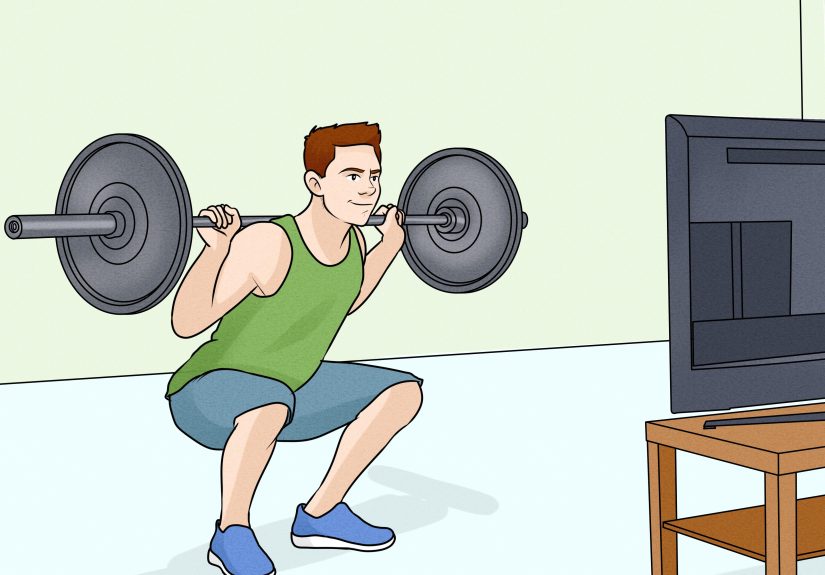
Cardio is great. But strength training is the secret sauce that helps daily life feel easiercarrying groceries, climbing stairs, getting up from the floor, and generally feeling like your body is on your team.
The best part? You can strength train while watching TV with minimal equipment (or none). The key is choosing moves that don’t require you to stare at the floor the entire time like it owes you money.
Option A: Resistance Band “TV Set” (Quiet, Effective, Portable)
Keep a band near the couch and cycle through this routine during an episode:
- Band Rows (10–15 reps): Anchor the band around your feet, pull elbows back.
- Biceps Curls (10–15 reps): Stand or sit tall, curl with control.
- Squat + Band Pull-Apart (8–12 reps): Squat while pulling the band apart at chest height.
- Side Steps with Band (10 steps each way): Band around thighs or ankles; stay low.
Do 1–3 rounds depending on your time. If it burns (in a normal “I’m using muscles” way), you’re doing it right.
Option B: Light Dumbbells or Household Weights
No dumbbells? Two water bottles, a backpack with books, or canned goods can work for light resistance. Focus on slow, controlled reps:
- Goblet squat (hold weight at chest)
- Overhead press (press weights above shoulders)
- Hinge / deadlift pattern (push hips back, stand tall)
- Farmer carry (walk around the room holding weights)
Option C: Bodyweight Strength (No Gear, No Excuses)
Try a simple “every 10 minutes” rule: every 10 minutes of an episode, do one set:
- 10–12 squats
- 8–12 push-ups (wall, couch, or floor)
- 10 lunges per side (or split squats holding the couch for balance)
- 20–30 seconds of a wall sit
Safety note: Keep movements controlled. If you’re using the couch for balance, use the stable part (not the decorative pillow that lies about being supportive).
Way 4: Mobility + Core on the Couch (Yes, the Couch Can Be Redeemed)
Some days, you don’t want a “workout.” You want to unwind. Mobility and core work are perfect for thatespecially if you’ve been sitting a lot. These moves can improve how your body feels, support posture, and help you move better in everything else you do.
The Couch Mobility Flow (10 Minutes, No Sweat Required)
- Seated posture reset (1 minute): Sit tall, roll shoulders back, gentle chin tuck.
- Seated twist (30 seconds each side): Rotate gently from the upper back, not the low back.
- Hip flexor stretch (1 minute each side): Half-kneeling lunge stretch beside the couch.
- Hamstring stretch (1 minute each side): Heel on ottoman or step, hinge forward slightly.
- Calf stretch (1 minute): Hands on wall, one foot back, press heel down.
TV-Friendly Core (No Crunch Marathon Needed)
Core training isn’t just absit’s stability. Try these low-drama, high-payoff moves:
- Dead bug (6–10 reps per side): Slow and controlled.
- Bird dog (6–10 reps per side): Keep hips steady.
- Glute bridge (10–15 reps): Squeeze glutes at the top.
- Side plank (modified) (15–25 seconds per side): Knees bent if needed.
Pro tip: Mobility work pairs well with TV because it doesn’t require constant focus. If the plot gets spicy, your stretch can stay calm. Balance in all things.
Bonus: How to Make TV-Time Exercise a Habit (Without Hating It)
The best routine is the one you’ll actually do. Here’s how people make this work in real life:
1) Use “Habit Stacking”
Attach movement to a TV habit you already have. Examples:
- “When the intro starts, I stand up and march.”
- “Every episode = one strength circuit.”
- “Credits = mobility stretch.”
2) Pick a Minimum You Can Win
On low-energy days, set the bar hilariously achievable: one commercial break, five minutes of marching, or one set of squats. Consistency beats intensity. And once you start, you often do more anyway.
3) Keep Gear Visible
If your resistance band is in a drawer, it might as well be in another galaxy. Leave it by the couch. Same for light weights. Make the “good choice” the easy choice.
4) Track It Like a Game
Create a simple points system:
- 1 point per commercial-break circuit
- 1 point per 10 minutes of cardio-in-place
- 1 point per mobility flow
Aim for 5–10 points per week. You’ll be surprised how quickly it adds upwithout requiring “gym motivation,” which is famously unreliable.
5) Remember the Big Picture
Most health guidelines emphasize that moving more and sitting less matters. TV workouts are a practical way to break up long sitting time and build toward weekly activity goalswithout needing to overhaul your entire schedule.
Extra Experiences: What TV-Workouts Really Feel Like (and Why People Keep Doing Them)
Let’s talk about the part nobody tells you: exercising while watching TV feels a little weird at first. Not “I’m doing something wrong” weirdmore like “Why am I marching during a courtroom drama?” weird. That’s normal. Most people have a short adjustment period where their brain is learning a new rule: screen time doesn’t have to equal statue time.
Experience #1: The ‘Commercial Break Athlete’ Identity
People who use commercial breaks often describe it like a mini game. The break starts and it’s go-time: a set of squats, a quick plank, a few push-ups, done. At first, you might catch yourself thinking, “This is too small to matter.” Then you realize you’re doing 40–80 squats in a night without scheduling anything. The surprise win is how it changes your self-image. Instead of “I didn’t work out today,” it becomes “I moved a bunchwithout making a big production out of it.” That identity shift is powerful, because it makes tomorrow easier.
Experience #2: The ‘Streaming Show Problem’ (and the Fix)
Streaming is great… until you realize there are no built-in breaks. People often say the hardest part is remembering to move when the next episode auto-plays like a very polite, very persuasive robot. The fix most people like is a simple rule: stand up at the start of each episode, or do one circuit between episodes. That “between episodes” moment is a natural pause where your brain is already transitioning. If you attach movement there, it feels less disruptivelike brushing your teeth, but for your legs.
Experience #3: Finding the “Right Kind” of Movement for Your Mood
Not every day calls for the same intensity. Some nights you want to sweat. Some nights you want to decompress. People who stick with TV workouts usually build a two-lane system: an “up” lane (cardio-in-place, circuits, step-ups) and a “down” lane (mobility, stretching, gentle core). The surprising benefit is emotional. The up lane can feel energizinglike you reclaimed a piece of your day. The down lane can feel calminglike your body finally got permission to release tension from sitting.
Experience #4: The “I Can’t Hear the TV” Moment
Real talk: if you start doing jumping jacks right next to the speakers, you might miss a line or two. Many people naturally evolve toward quiet cardio (marching, step jacks, heel raises, fast walking in place) and strength moves that don’t require impact. A common setup is keeping the volume a touch higher, using subtitles, or choosing exercises that match the scene type: move more during action, slow down during important dialogue. Subtitles are basically the unsung heroes of at-home workouts.
Experience #5: Social TV Turns Into “Casual Competition”
Families and roommates often turn this into a playful challenge: “Every time someone says that phrase, we do 5 squats,” or “Who can hold a wall sit through the recap?” It sounds silly (because it is), but that silliness makes the habit stick. When movement feels like a game, it’s easier to repeat. And repetition is where results come fromstronger legs, better stamina, less stiffness, and that satisfying feeling that you did something good for yourself without sacrificing your favorite show.
Experience #6: The Unexpected ‘I Feel Better’ Payoff
One of the most consistent reports from people who try this for a couple weeks is that they feel less stiff after TV time. Instead of standing up like a question mark, they stand up like a person. They also notice small functional winsstairs feel easier, posture feels more natural, and they’re less likely to fall into a full evening of unbroken sitting. It’s not magic. It’s just the compound effect of frequent movement.
If you want a simple “starter week,” many people do this:
- 3 days: Commercial-break circuit
- 2 days: Cardio-in-place during one episode
- 2 days: Mobility + core flow
That’s it. No overhaul. Just a smarter way to use time you’re already spending.
Conclusion
Exercising while watching TV isn’t about turning entertainment into punishment. It’s about turning a daily habit into an opportunity. Use commercial breaks for quick circuits, keep your heart rate up with cardio-in-place, build strength with bands/weights/bodyweight, and protect your joints and posture with mobility + core. Pick the option that matches your mood, keep the “minimum” easy, and let consistency do the heavy lifting.
Now go forth and become the kind of person who can finish an episode and casually knock out a workoutlike a multitasking legend with excellent taste in TV.