Table of Contents >> Show >> Hide
- Ancient & Classical Myths: Marble, Sand, and Very Persistent Rumors
- 1. The pyramids were built by slaves
- 2. Cleopatra was “Egyptian” in the way people usually mean it
- 3. Ancient Greek and Roman statues were naturally white
- 4. “Only 300 Spartans” fought at Thermopylae
- 5. Gladiators fought to the death every time
- 6. Romans built “vomitoriums” so they could throw up and keep eating
- 7. The Trojan Horse is a confirmed historical event
- 8. The Library of Alexandria burned once and erased ancient knowledge overnight
- Medieval & Renaissance Myths: Pop Culture’s Favorite Time Machine
- 9. The “Dark Ages” were a universal intellectual blackout
- 10. Medieval Europeans thought the Earth was flat
- 11. Columbus “proved” the Earth was round
- 12. Vikings wore horned helmets
- 13. Vikings drank from skulls
- 14. Medieval people never bathed and everyone smelled like doom
- 15. Knights lived in full shiny plate armor 24/7
- 16. The Iron Maiden was a standard medieval torture device
- 17. Witch hunts killed “millions and millions” (often quoted as 9 million)
- Revolutions & Empires: Misquotes, Mis-measurements, and Misbehavior
- American History Myths: The Versions We Learned Between Fire Drills
- 22. Paul Revere rode alone shouting, “The British are coming!”
- 23. The Boston Tea Party was a protest against a tea tax hike
- 24. The Declaration of Independence was signed on July 4, 1776
- 25. The Pilgrims always dressed in black with buckle hats
- 26. Betsy Ross definitely sewed the first American flag on Washington’s request
- 27. George Washington had wooden teeth
- Modern Myths: Cameras Were Invented, and Yet Here We Are
- Why These History Myths Won’t Die (and What to Do About It)
- of Real-World “Wait… That’s Not True?” Experiences
History has a PR problem. Not because it’s boring (it’s basically a reality show with worse haircuts), but because
the versions we repeat are often the “greatest hits” of misunderstanding: catchy, dramatic, and only loosely
supervised by evidence.
This article debunks 31 historical misconceptionsthe kind that sneak into textbooks, movies,
tour guides, and your uncle’s dinner-table monologues. And because the best history isn’t just “gotcha!” trivia,
each correction comes with the bigger takeaway: how myths form, who benefits, and what the real story changes about
the way we see the past (and ourselves).
Ancient & Classical Myths: Marble, Sand, and Very Persistent Rumors
1. The pyramids were built by slaves
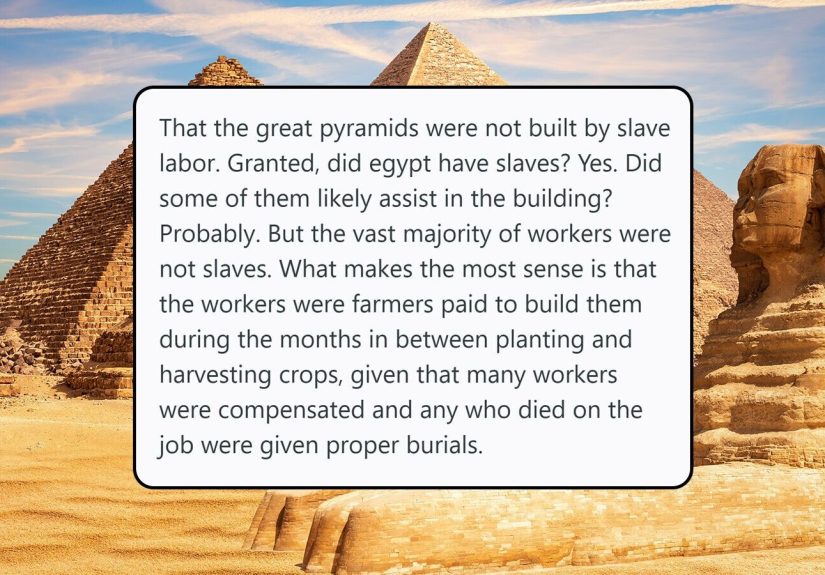
The pyramids are often framed as a slave-powered mega-project. But strong archaeological evidence points to
organized laborpaid workers, rotating crews, and support systems (food, housing, medical care). The myth matters
because it turns sophisticated state logistics into a one-note tale of cruelty, and it erases the workers’ skill.
2. Cleopatra was “Egyptian” in the way people usually mean it
Cleopatra ruled Egypt, spoke Egyptian, and played the role brilliantlybut she was from the Macedonian Greek
Ptolemaic dynasty. Correcting this doesn’t make her less “of Egypt”; it shows how power and identity work in
empires: rulers can be culturally fluent while politically foreign.
3. Ancient Greek and Roman statues were naturally white
Museums trained us to think “classical” equals glowing white marble. In reality, many ancient sculptures and
temples were paintedboldly. This changes how we imagine the ancient world: not minimalist and sterile,
but loud, colorful, and visually competitive (like your neighbor’s holiday lights, but with gods).
4. “Only 300 Spartans” fought at Thermopylae
The Spartans were the headline act, but they weren’t the whole festival. Greek allies fought toothousands of them.
The misconception shrinks a coalition effort into a solo superhero story, which is convenient for movies and
inconvenient for understanding how alliances (and sacrifice) actually work.
5. Gladiators fought to the death every time
Pop culture treats the arena like a guaranteed exit ramp. In reality, training gladiators was expensive, and many
bouts ended with survivalespecially when crowds, referees, and sponsors had a stake in keeping talent alive. The
correction reframes Rome as calculating entertainment economics, not constant blood-lust chaos.
6. Romans built “vomitoriums” so they could throw up and keep eating
The word vomitorium sounds like a kitchen gadget you’d never buy, but it actually referred to stadium
passageways that “spewed” crowds out quickly. Believing the myth paints Romans as cartoonishly decadent and lets us
dodge the more interesting truth: they engineered mass public life at scale.
7. The Trojan Horse is a confirmed historical event
Troy was real. Conflict in that region was real. But the wooden-horse story sits in the realm of epic tradition,
not a police report. Whether it’s metaphor, propaganda, or mythic storytelling, the bigger point is how cultures
use “clever victory” tales to explain trauma and justify domination.
8. The Library of Alexandria burned once and erased ancient knowledge overnight
The popular version is a single tragic blaze that set humanity back a thousand years. The reality is messier:
damage likely occurred across multiple episodes and centuries, and “loss” can also look like slow neglect,
underfunding, and political instability. This myth changes everything because it teaches the wrong lesson:
knowledge doesn’t only die in flamesit can fade in silence.
Medieval & Renaissance Myths: Pop Culture’s Favorite Time Machine
9. The “Dark Ages” were a universal intellectual blackout
The label makes for dramatic narration, but it oversimplifies a long, varied period filled with scholarship,
technology, and cross-cultural knowledge exchange. When we call it “dark,” we quietly claim progress is automatic.
History says it isn’tand that’s a useful warning.
10. Medieval Europeans thought the Earth was flat
Educated people in medieval Europe largely knew the Earth was roundthanks to inherited classical learning and
their own scholarship. The “everyone thought it was flat” story is a later invention that flatters modern audiences.
It turns history into a smug victory lap instead of a complicated relay race.
11. Columbus “proved” the Earth was round
Columbus wasn’t battling flat-Earth theologians like a heroic science influencer. The debate was more practical:
how big was the Earth, and could ships survive the route? This correction matters because it reveals how modern
myth-making uses fake conflicts to dramatize “reason vs. ignorance.”
12. Vikings wore horned helmets
Archaeology doesn’t support horned battle helmets as standard Viking gear. The iconic look is largely a
19th-century artistic costume that stuckbecause it’s instantly recognizable and wonderfully ridiculous in a fight.
The bigger lesson: visuals can outlive facts by centuries.
13. Vikings drank from skulls
The skull-cup Viking is more vibe than verifiable habit. Like horned helmets, it’s a dramatic stereotype that
survives because it’s memorable. Dropping it changes the story from “savage outsiders” to real societies with law,
trade, and everyday routinesyes, including grooming and hygiene.
14. Medieval people never bathed and everyone smelled like doom
Medieval hygiene wasn’t modern hygiene, but “no one bathed” is an exaggeration. Bathing practices varied by region,
wealth, and timeand public bath culture existed in many places. The myth sticks because it makes us feel superior,
which is not a historical method, it’s a personality trait.
15. Knights lived in full shiny plate armor 24/7
Plate armor evolved over time and was used strategically; it wasn’t a permanent lifestyle accessory. Even when it
was common, a knight didn’t eat breakfast in a helmet unless breakfast was “heatstroke.” Fixing this changes how we
picture warfare: less fantasy cosplay, more practical choices under brutal constraints.
16. The Iron Maiden was a standard medieval torture device
Many famous “medieval” torture devices gained popularity latersometimes as museum theater, sometimes as moralizing
propaganda about the past. The Iron Maiden is a prime suspect in this category. The correction matters because it
shows how later generations invented horrors to make earlier people look uniquely barbaric.
17. Witch hunts killed “millions and millions” (often quoted as 9 million)
The scale of European witch-hunt violence was real and horrifying, but the “millions” figure is widely viewed as
inflated. Better estimates are far lower (still tragic). Why it changes everything: accuracy honors victims and
helps us understand how panic spreadswithout turning history into a numbers contest.
Revolutions & Empires: Misquotes, Mis-measurements, and Misbehavior
18. Marie Antoinette said, “Let them eat cake”
There’s no solid evidence she said it, and versions of the phrase appear elsewhere earlier. The quote works as a
symbol of elite indifference, which is exactly why it stuck. The real story teaches a sharper lesson: propaganda
doesn’t need to be trueit only needs to feel true.
19. Napoleon was unusually short (aka the original “short king”)
Napoleon’s height was likely around average for his era; confusion grew from different measurement systems and
gleeful enemy propaganda. The myth matters because it turns geopolitics into psychology: empires don’t rise because
someone is mad at a top shelf.
20. Catherine the Great died in a horse-related scandal
No. She died after a stroke. The horse rumor is an old-school smear campaignsexualized propaganda aimed at a
powerful woman. Correcting it doesn’t just save her reputation; it exposes a pattern: scandal is often used as a
shortcut to discredit authority when facts won’t cooperate.
21. Salem “witches” were burned at the stake
The Salem executions were by hanging (and one accused man was pressed to death), not burning. The correction is
more than technical: it connects Salem to English legal practice and colonial panic, rather than importing a
European image that doesn’t match the local record.
American History Myths: The Versions We Learned Between Fire Drills
22. Paul Revere rode alone shouting, “The British are coming!”
Revere wasn’t a solo superhero, and shouting that line would’ve been… unhelpful, given many colonists still saw
themselves as British. The alarm system involved multiple riders and networks. The myth matters because it turns
community coordination into a single “great man” moment.
23. The Boston Tea Party was a protest against a tea tax hike
Ironically, the Tea Act could make tea cheaperpartly by helping the East India Company. The anger was about power:
monopoly influence, taxation politics, and representation. This shift changes the story from “price protest” to a
deeper argument over who gets to set the rules.
24. The Declaration of Independence was signed on July 4, 1776
July 4 is when Congress adopted the final text. The signing process stretched beyond that (with a major signing
date often cited in early August). The correction matters because it highlights how nation-making is procedural,
not instantaneousmore paperwork, fewer fireworks.
25. The Pilgrims always dressed in black with buckle hats
That outfit is basically a costume invented by later imagination. Real clothing in the 1600s used color and varied
materials, and the buckle-everything look is a much later visual shorthand. This matters because stereotypes can
flatten real lives into a single “Thanksgiving clipart” aesthetic.
26. Betsy Ross definitely sewed the first American flag on Washington’s request
The story is famous, but the strongest evidence appears long after the fact, largely through family testimony.
Flags existed in many forms, and design credit is complicated. The correction doesn’t erase Ross; it reminds us
that origin stories often get polished into neat little bows.
27. George Washington had wooden teeth
“Wooden teeth” is one of America’s most durable myths, but his dentures were made from a mix of materialsnone of
which are as charming as wood (and some of which are frankly unsettling). The reality humanizes him and exposes how
medical techand painshaped leadership.
Modern Myths: Cameras Were Invented, and Yet Here We Are
28. The Great Wall of China is visible from the Moon (or easily from space)
It’s not visible from the Moon, and from low Earth orbit it’s not the obvious neon ribbon people imagine. This myth
persists because it’s a flattering idea: humans built something so big even space notices. Reality is cooler: space
is huge, your eyes are limited, and that’s not a personal attack.
29. Einstein failed math
The legend is comfortinggenius struggled too!but it’s misleading. Einstein was strong in math early on, and the
“failed math” story usually comes from mismatched grading systems or repeated retellings. The real inspiration is
better: he worked hard, asked weird questions, and kept going.
30. Mussolini “made the trains run on time”
This line is often used as a grim joke about authoritarian “efficiency.” But it’s widely treated as propaganda more
than realityan image-management strategy that outlived the facts. The correction matters because it shows how
dictators sell legitimacy: through stories of order, not proof of goodness.
31. Titanic was loudly marketed as “unsinkable,” and everyone bought it
Before the sinking, “unsinkable” language existed but often with qualifiers (“practically,” “virtually”) and was
amplified by press and public confidence. After the disaster, the word hardened into legend because it fit a moral
narrative about hubris. The deeper takeaway: tragedy rewrites memory, and slogans get sharper in hindsight.
Why These History Myths Won’t Die (and What to Do About It)
Misconceptions about history survive for the same reasons memes survive: they’re simple, emotional, and easy to
repeat. They give us heroes, villains, punchlines, and “everyone back then was dumb” comfort. The fix isn’t to
memorize more datesit’s to ask better questions.
When you hear a tidy story, try this: Who benefits if I believe this? Does it make a nation look
nobler, an enemy look crazier, a whole era look incompetent, or a complex system look like one dramatic moment?
Real history is rarely neat. That’s not a flaw. That’s the point.
of Real-World “Wait… That’s Not True?” Experiences
If you’ve ever had your historical worldview cracked open by a museum label, welcome to the club. You walk in
expecting the greatest hitsVikings, knights, pyramidsand then a small plaque calmly informs you that your mental
image was assembled by 19th-century artists, 20th-century movies, and one overly confident middle-school worksheet.
It’s a strange feeling: part embarrassment, part delight, like realizing the “fact” you’ve repeated for years was
actually a rumor with excellent marketing.
These misconceptions show up everywhere because they’re socially useful. In classrooms, a simplified myth is a fast
way to teach a big concept: “Columbus proved the world was round” becomes a quick symbol for curiosity and daring.
At trivia night, “Washington had wooden teeth” is a fun hook that’s easier to remember than “18th-century dental
materials were complicated and sometimes horrifying.” In movies, the myth is a shortcut that saves screen time:
horned helmets, “Dark Ages” grime, and gladiators dropping every match like it’s a one-round playoff.
But the most interesting “experience” is what happens when the myth breaks. Suddenly, history stops being a parade
of lone geniuses and becomes a network of people, institutions, and incentives. Paul Revere turns from a solo icon
into one node in a communications web. The Boston Tea Party shifts from a price complaint to a fight about power and
representation. The Library of Alexandria transforms from a single villainous fire into a warning about neglect,
politics, and the slow erosion of support for learning.
You can also feel the myth-busting effect in everyday conversations. Someone drops the Mussolini train line as a
“well, at least…” argument, and suddenly you’re talking about propaganda, state capacity, and why efficiency isn’t
the same as justice. Someone repeats the Catherine-the-Great horse rumor, and the room (ideally) notices how often
powerful women get reduced to scandalbecause scandal is a cheap substitute for serious critique. Myths aren’t just
wrong; they steer what we consider plausible about people and societies.
The best part is that once you start noticing these patterns, you can’t unsee them. You begin to ask: Is this story
tidy because it’s true, or tidy because it’s useful? Why do we prefer “one dramatic moment” over “long messy
process”? And why do we keep retelling the same few myths when the real history is usually more surprisingand more
human? That curiosity is the real upgrade. Not a pile of corrections, but a new habit of mind: enjoying the past
without letting folklore drive the car.