Table of Contents >> Show >> Hide
- Before You Buy Another Bin: The 3 Rules That Make Toy Storage Work
- 25 Toy Storage Ideas That Actually Help You Tidy Up
- 1) Low, open shelving (aka “Montessori-ish” magic)
- 2) A classic cubby-and-bin system
- 3) Slide-in bins (the “sort fast” superpower)
- 4) Clear, stackable lidded bins for toy sets
- 5) Labels that match your child’s reading level
- 6) The “one giant basket” emergency reset
- 7) Storage ottomans that hide chaos in plain sight
- 8) A sideboard or credenza for “grown-up looking” toy storage
- 9) Repurpose an armoire for a “toy closet” without renovations
- 10) Use the back of doors (it’s free real estate)
- 11) Hooks for dress-up, costumes, and capes
- 12) A dress-up station with a mirror and a basket
- 13) Pegboard + baskets = flexible storage that grows with your kids
- 14) Rolling carts for crafts and “in-progress” projects
- 15) Use drawer organizers for tiny accessories
- 16) Food storage containers for micro-toys
- 17) Zippered pouches for puzzles and board game pieces
- 18) Under-bed rolling drawers for bulky toys
- 19) Corner shelving to reclaim awkward spaces
- 20) Book ledges or front-facing book racks
- 21) A “toy library” closet with zones
- 22) Store by size (big bins for big toys, small bins for small parts)
- 23) A stuffed animal hammock (because they don’t need to be on your couch)
- 24) A stuffed-animal bean bag cover (stuffies that become furniture)
- 25) Outdoor toy corral for balls, chalk, and pool gear
- Maintenance Tips: How to Keep Toy Storage From Falling Apart by Thursday
- Real-Life “Experience” Notes: What Families Learn the Hard Way (So You Don’t Have To)
- Conclusion
Congratulations: your home has been selected as the official training ground for tiny humans, tiny accessories, and one million tiny pieces that canand willfind your bare foot in the dark.
If toy clutter is winning right now, you don’t need a bigger house. You need a smarter systemone that works with real life: quick cleanups, busy weekdays, and kids who can’t read yet but can absolutely negotiate like attorneys. Below are 25 toy storage ideas that make toy organization easier, keep your floors visible (remember floors?), and help your kids actually put things away without you narrating every step like a sports commentator.
Before You Buy Another Bin: The 3 Rules That Make Toy Storage Work
Rule 1: Store toys where they get used
The best toy storage solutions are the ones that don’t require a cross-country expedition. If blocks always end up in the living room, give them a “home base” nearby. When storage matches real behavior, cleanup stops feeling like an unfair side quest.
Rule 2: Fewer choices = better play (and faster cleanup)
When everything is out, kids bounce from toy to toy like they’re speed-dating. A curated selection on accessible shelves can improve focus and make the room feel calmerplus it’s far easier to reset.
Rule 3: Categories should be “kid-sized,” not Pinterest-sized
You might want separate bins for “blue magnetic tiles,” “green magnetic tiles,” and “magnetic tiles that have seen things.” Kids want “magnetic tiles.” Aim for broad, obvious categories first. You can always subdivide later if you’re feeling brave (or you just stepped on another mini dinosaur).
25 Toy Storage Ideas That Actually Help You Tidy Up
1) Low, open shelving (aka “Montessori-ish” magic)
A low shelf with a few toys displayed front-and-center encourages independent play and independent cleanup. Keep the shelf lightly stocked so it looks inviting, not like a toy store after a hurricane warning.
2) A classic cubby-and-bin system
Cubby shelves with bins are a staple for playroom organization because they’re simple: one bin per category. Bonus points if bins are lightweight so kids can carry them to the play area and back.
3) Slide-in bins (the “sort fast” superpower)
Storage frames with slide-in plastic bins are excellent for toys that multiply. Assign bins to categories like cars, dolls, pretend food, and “mystery parts I’m afraid to throw away.” This is especially effective for toddlers because bins pull out like drawersno lid wrestling required.
4) Clear, stackable lidded bins for toy sets
For toys with multiple pieces (train tracks, building sets, doll accessories), use clear lidded bins so you can see what’s inside. The goal is to keep a set complete and easy to grabwithout dumping everything out to find one missing piece.
5) Labels that match your child’s reading level
Words work for readers. Pictures work for non-readers. A combo works for everyone. Labeling is one of the fastest ways to turn “clean up!” into “return items to their habitats.”
6) The “one giant basket” emergency reset
Keep a large basket or rope hamper for the days when you need a five-minute tidy before guests arrive (or before you lose your mind). Scoop everything in quickly, then sort later when you have time. It’s not cheating; it’s triage.
7) Storage ottomans that hide chaos in plain sight
In living rooms, a storage ottoman doubles as seating and a toy vault. Choose something sturdy and easy to open. This is a top-tier solution when you want the room to look like adults live there too.
8) A sideboard or credenza for “grown-up looking” toy storage
Closed cabinets are a game-changer for shared spaces. Use baskets or bins inside the cabinet so toys don’t become one giant mixed pile. Doors shut, sanity restored.
9) Repurpose an armoire for a “toy closet” without renovations
An old wardrobe or armoire can become a toy command center: shelves for games, bins for sets, hooks inside for dress-up items. Close the doors when company arrives and enjoy your Oscar-worthy illusion of order.
10) Use the back of doors (it’s free real estate)
Hang an over-the-door organizer to store small toys, art supplies, dolls, or action figures. This is one of the best small space toy storage tricks because it adds storage without taking up floor area.
11) Hooks for dress-up, costumes, and capes
Costumes get messy fast. Use wall hooks, command hooks, or a peg rail so kids can hang items themselves. Add a small bin below for accessories (tiaras, masks, wandsstandard royal inventory).
12) A dress-up station with a mirror and a basket
If dress-up is a daily event, make it official: a mirror at kid height, a few hooks, and a basket for hats and props. You’ll reduce costume sprawl and also witness surprisingly intense fashion decisions.
13) Pegboard + baskets = flexible storage that grows with your kids
Pegboard isn’t just for garages. Add small baskets and cups for art supplies, LEGO minifigs, or figurines. As interests change, you can rearrange hooks and containers without buying new furniture.
14) Rolling carts for crafts and “in-progress” projects
A rolling cart can hold coloring supplies, Play-Doh tools, sticker books, and all the stuff that’s always half-finished. Roll it out for use, roll it away when you need the table back for dinner.
15) Use drawer organizers for tiny accessories
Barbie shoes. Puzzle pieces. Doll-sized forks. Tiny plastic animals with unsettlingly realistic eyes. Use drawer dividers or small compartment organizers so small parts don’t become a single tangled ecosystem.
16) Food storage containers for micro-toys
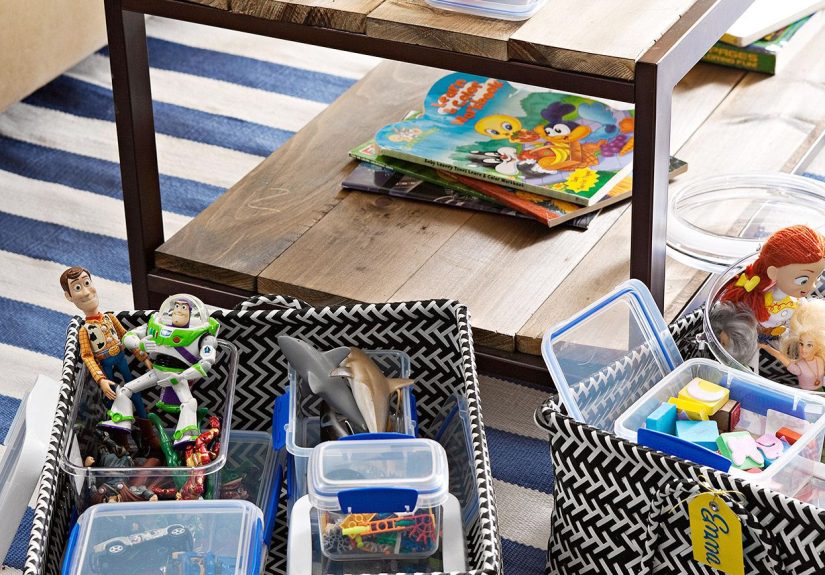
Clear food containers with snap lids are surprisingly great for toy categories like cars, figurines, crayons, or building pieces. They stack neatly and make it obvious what belongs where.
17) Zippered pouches for puzzles and board game pieces
Loose puzzle pieces and game parts love to wander. Store each set in a labeled zipper pouch or zippered envelope, then stack them vertically in a bin. It’s tidy, portable, and dramatically reduces “Where is the spinner?” incidents.
18) Under-bed rolling drawers for bulky toys
Use under-bed bins for train sets, large vehicles, or backup toys you’re not rotating in right now. Rolling drawers are easiest for kids to access without pulling out half the room to reach a bin.
19) Corner shelving to reclaim awkward spaces
Corners often sit empty, but they’re perfect for narrow shelves or corner bookcases. Built-in-looking storage without the built-in budgetmusic to any parent’s ears.
20) Book ledges or front-facing book racks
Kids are more likely to read (and re-shelve) books when covers face outward. A front-facing rack keeps books visible and prevents the dreaded “book pile avalanche.”
21) A “toy library” closet with zones
Dedicate a closet to toys if you don’t have a playroom. Add shelves and bins, then create zones: building toys, pretend play, crafts, puzzles/games. Close the door when you want instant calm.
22) Store by size (big bins for big toys, small bins for small parts)
When small toys go into huge bins, kids dig, dump, and abandon. Small containers reduce digging and keep sets intact. Big bins are best for big, soft, or chunky items.
23) A stuffed animal hammock (because they don’t need to be on your couch)
Stuffed animals take up space like they pay rent. Hang a toy hammock in a corner to keep them off the floor while still visible and accessible.
24) A stuffed-animal bean bag cover (stuffies that become furniture)
This one is delightfully sneaky: you “store” stuffed animals by turning them into a bean bag chair. Kids love it, you get seating, and the plush army is contained.
25) Outdoor toy corral for balls, chalk, and pool gear
For backyard clutter, use a ventilated hamper, mesh bin, or deck box. Hang hooks for pool floats or gear on a fence or shed wall. Outdoor toys are happiest when they can dry out and stay contained.
Maintenance Tips: How to Keep Toy Storage From Falling Apart by Thursday
- Do a nightly “10-item reset.” Everyone returns 10 things to their homes. It’s fast, achievable, and strangely effective.
- Keep labels honest. If “Cars” becomes “Cars + Random Dinosaurs,” fix the system instead of blaming the child (dinosaurs are persuasive).
- Leave 20% empty space. Storage that’s packed to the brim is hard to maintain. A little breathing room makes it easier to put things away neatly.
- Anchor tall furniture. If you’re using shelves or cabinets, secure them to the wall for safetyespecially in kids’ spaces.
Real-Life “Experience” Notes: What Families Learn the Hard Way (So You Don’t Have To)
Let’s talk about the part most articles skip: the messy middle. You can buy the prettiest bins in America, label them with a label maker that costs more than your first car, and still end up with a floor full of blocks by 4:12 p.m. Because the secret isn’t perfect storageit’s human-proof storage.
Lesson #1: If a kid can’t open it, it doesn’t exist. Many parents report the same pattern: lids that snap too tightly, drawers that stick, or bins stored too high become “invisible.” Invisible toys magically migrate to the floor because the only accessible “home” is… anywhere. The fix is simple: keep daily-use toys in open bins or easy-pull drawers at kid height. Save lidded bins for long-term storage, rotation, or special sets you supervise.
Lesson #2: Too many categories creates decision fatigue. Adults love micro-categories. Kids love momentum. If cleanup requires deciding whether a figure is a “superhero” or “action figure” or “tiny plastic guy,” you will lose valuable minutes and possibly your will to live. Families tend to stick with systems that use broad categories first: “Blocks,” “Cars,” “Pretend Food,” “Art,” “Dress-Up,” “Games.” You can always add a smaller bin inside later for “tiny pieces that hurt” (looking at you, LEGO).
Lesson #3: The living room needs a “closing time” routine. When toys live in shared spaces, the best systems include a nightly reset that’s short enough to actually happen. A common win: one attractive basket for quick pickup, plus one closed cabinet/ottoman to hide the basket when you’re done. The basket collects the chaos fast; later, you do a calmer “sort and return” when the house is quieter. It’s the same logic as putting dishes in the sink before you load the dishwasherprogress counts.
Lesson #4: Rotation is not a moral failingit’s a strategy. Parents often worry that putting toys away means kids won’t play with them. In reality, rotating toys can increase interest because the shelf feels fresh. A practical rotation many families use is three to six groups of toys, swapped every couple of weeks (or sooner if boredom strikes). Keep favorites accessible (like a big LEGO set), and rotate the rest. Fewer toys out means faster cleanup and more focused play. This is especially helpful for kids who get overwhelmed by too many choices.
Lesson #5: The “right” storage is the one your family will use. Some households thrive with clear bins because everyone can see what’s inside. Others prefer opaque bins because visual clutter feels stressful. Some kids need picture labels; others love color coding. The best approach is to test one zone firstmaybe the blocks or the art suppliesthen expand what works. If something constantly fails, don’t double down with stricter rules. Change the container, lower the shelf, widen the category, or move the storage closer to where play happens.
Lesson #6: Expect the system to evolve. Today you’re organizing chunky toddler toys. Tomorrow you’re managing miniature accessories and collectibles that look like they were designed by a tiny prankster. As kids grow, switch from big open bins to smaller divided organizers and drawers. One of the most sanity-saving shifts families mention is moving “small stuff” into compartmentalized containers before it becomes a permanent carpet feature.
In short: a tidy toy system isn’t about perfection. It’s about reducing friction. If cleanup takes fewer steps than making the mess, you win. And if you can make it even slightly funrace the timer, play a cleanup song, or assign everyone a “toy category”you’re not just tidying up. You’re training future roommates. You’re welcome, society.
Conclusion
Toy clutter doesn’t need to be your home’s permanent aesthetic. With a few smart toy storage ideasopen shelves for everyday play, bins that match toy size, labels kids can follow, and a simple rotation strategyyou can keep your space functional and livable. Start with one problem area, choose a system you’ll actually maintain, and remember: the goal isn’t a museum. It’s a home where everyone can find what they needand where your feet can safely exist.