Table of Contents >> Show >> Hide
- Why the 1950s Needed a “Switching” Supply
- Meet the Electromechanical “Vibrator”
- What’s Inside the Box: A Mechanical SMPS Block Diagram
- Frequency: The Sweet Spot Around 115 Hz (And Why)
- The Problem Child Called “Hash”
- Real-World 1950s Examples That Prove This Wasn’t a Hack
- Bonus Context: Not All 1950s “Clever Power” Was Mechanical
- How a Mechanical Switcher Compares to a Modern SMPS
- Keeping One Alive Today (Without Making Your Radio Hate You)
- Hands-On Experiences: Living With a Mechanical Switcher (About )
- Conclusion
Today, the phrase switching power supply usually conjures tiny chips, fast MOSFETs, and engineers arguing about snubber networks like it’s a competitive sport. But in the 1950s, plenty of switching power supplies were already “switching”… with something far more dramatic: a mechanical device that literally flapped contacts back and forth at audio-ish speed. It was loud, a little cranky, and shockingly clever.
If you’ve ever wondered how engineers got high-voltage “B+” for vacuum tubes from a humble 6-volt car batterywithout a modern inverterwelcome to the era of the electromechanical vibrator power supply. Yes, that’s the real name. Yes, it buzzed. And yes, it’s basically the original “switcher,” powered by a tiny metal reed having the world’s most productive nervous tic.
Why the 1950s Needed a “Switching” Supply
Vacuum tubes wanted high voltage. Cars didn’t.
Mid-century electronics ran on tubes, and tubes are voltage-hungry. A typical tube radio might need something like 90–300 volts DC for plate and screen circuits (that’s your “B+”), plus lower voltage for filaments/heaters. Meanwhile, vehicles and field gear offered convenient DC sourcesoften 6V, 12V, or sometimes 24Vbecause batteries are great at being batteries and terrible at being high-voltage wall outlets.
Two classic answers: spinning machines or buzzing boxes
Early solutions sometimes used motor-generator sets (dynamotors): a DC motor turning an AC generator, then rectified back to DC. It worked, but it was bulky, heavy, and full of bearings that didn’t care about your budget or your patience. The 1950s loved a lighter, cheaper trick: interrupt the DC fast enough to drive a transformer, then rectify the transformer’s output. No spinning shafts requiredjust a metal reed and some contacts willing to take a beating.
Meet the Electromechanical “Vibrator”
A relay that can’t stop fidgeting
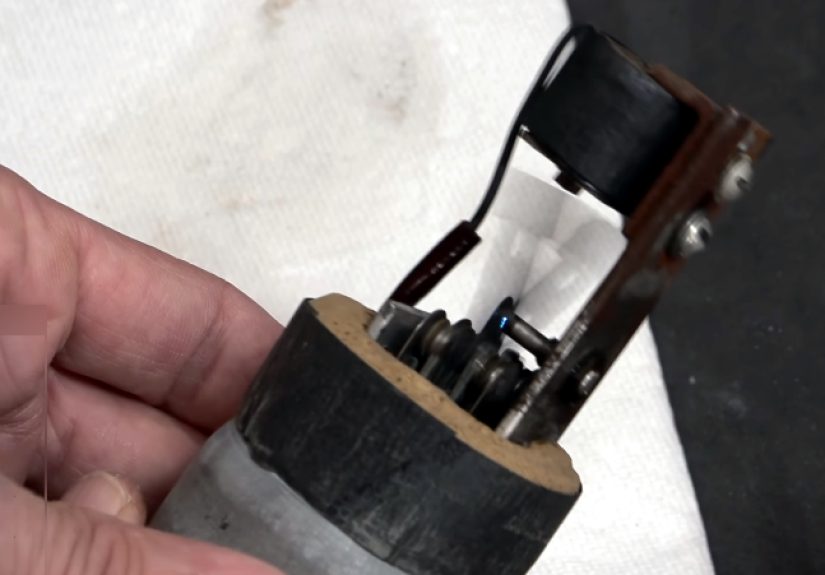
A vibrator power supply uses a small electromagnet and a springy reed with contacts. Once energized, the reed oscillates, repeatedly opening and closing contacts. That switching action chops the battery’s DC into a rough alternating waveform (more like a square wave with opinions). Feed that into a transformer primary, andboomyou can step the voltage up.
In plain English: the vibrator is a self-oscillating mechanical switch that converts low-voltage DC into transformer-friendly AC. Then the rest of the power supply does what power supplies always do: rectify, filter, and (sometimes) regulate.
What’s Inside the Box: A Mechanical SMPS Block Diagram
Stage 1: DC gets chopped
The vibrator’s contacts alternately route current through halves of a transformer primary (or otherwise reverse/interrupt current), creating a changing magnetic field. The switching frequency is set by the vibrator’s mechanical designits mass, spring tension, and geometry. It’s engineering by physics, not firmware.
Stage 2: The transformer does the heavy lifting
Once the primary sees that chopped waveform, the transformer steps it up to a higher AC voltage on the secondary. This is the key: transformers want changing current. A steady DC input does nothing useful, but switched current gives you the magnetic flux swings the transformer lives for.
Stage 3: Rectificationtube, gas, selenium, or… more contacts
The stepped-up AC is then rectified. In many consumer and service examples, you’ll see tube rectifiers, and in lots of car radios you’ll find gas rectifiers (a famous example is the 0Z4), followed by filtering to smooth the B+. Some designs go full mechanical and use a synchronous vibrator: a second set of timed contacts that mechanically rectifies the transformer output, eliminating the rectifier tube. Neat ideaalso more parts to misbehave.
Stage 4: Filtering and regulation
After rectification, classic LC filters (chokes and capacitors) smooth ripple. Regulation varies by application: some sets accept a little drift; others add regulator tubes, or more elaborate circuits, to keep voltage stable under changing load and battery conditions.
Frequency: The Sweet Spot Around 115 Hz (And Why)
Most vintage radio vibrators settled around ~115 Hz. That number wasn’t arbitrary: it was a compromise between transformer size, audible noise, ripple frequency, efficiency, and the brutally practical reality that every “click” is contact wear. Higher frequency can shrink magnetics and raise ripple frequency (easier filtering), but it also increases the number of makes/breaks per hourso the contacts age faster.
As designs improved and military needs pushed for smaller gear, higher-frequency units appeared. A commonly discussed “next step” was around 250 Hz, which could reduce transformer size further while staying within what real-world mechanical contacts could tolerate.
The Problem Child Called “Hash”
Mechanical switching has a personality trait: it sparks. When contacts open under load, you can get arcingbad for contact life and great for radiating interference. In radio service literature, this interference is often called “hash”: the crackly, raspy noise that can leak into the receiver’s own circuitry if suppression and filtering aren’t done well.
Buffer capacitors: small part, big job
One of the key parts in many vibrator supplies is the buffer capacitor. It helps tame voltage spikes created by the transformer’s inductance and the abrupt switching transitions. It also reduces contact arcing and improves overall operationso much so that service guidance often treats the buffer capacitor and vibrator as a “replace together” pair if you want your repair to last longer than a victory lap around the block.
Chokes, bypassing, and shielding
Designers also used chokes and capacitors to keep switching noise out of sensitive circuits, plus physical shielding: the vibrator is typically sealed in a metal can, and the entire power supply may live in a compartment. That “mystery hum” you hear in some old equipment isn’t your imaginationit’s the mechanical switch doing its job.
Real-World 1950s Examples That Prove This Wasn’t a Hack
Example 1: Military vehicular powerPP-114/VRC-3
Military radio gear needed to run from whatever vehicle showed up: 6V, 12V, or 24V systems were all common. One example is a vibrator power supply designed to operate across multiple input ranges and deliver several output rails for radio equipment. Documentation for a Signal Corps vibrator supply describes operation across 6/12/24V input positions and lists output rails including a “high B” and “low B,” along with filament output, all with specified load limits and current draw. In other words: this wasn’t a novelty. It was a standardized, spec’d piece of power infrastructure.
Example 2: Science in the fieldgear powered from cars and planes
Vibrator supplies weren’t just about entertainment. Field instrumentslike mid-century radiation detection and geophysical equipmentoften had to run off vehicle power. Technical descriptions of portable instrumentation explicitly note B power derived from a vehicle’s 6V or 12V system through a “standard commercial design” vibrator supply, with tubes and regulation stages built around that reality. If your measurement device has to work reliably on a bumpy road with a battery that droops under load, you don’t pick fragile solutions.
Example 3: High-end receivers that planned for DC operation
Some serious receivers included provisions for running from battery plus a vibrator-type pack (or equivalent B supplies). Manuals spell out the need for a high-voltage DC rail alongside a low-voltage filament supply, and they even warn about the significant battery drain. That’s a reminder: the system worked, but physics always sends an invoice.
Bonus Context: Not All 1950s “Clever Power” Was Mechanical
The 1950s were also an era of alternative power-control technologies. For regulation and control in heavy-duty systems, magnetic amplifiers (saturable reactors) were widely used and heavily discussed in American engineering circles, including naval applications. They weren’t “switchers” in the modern high-frequency MOSFET sense, but they were an important part of the power-supply landscape: rugged, tolerant of abuse, andcruciallycapable of controlling large power flows with smaller control currents.
That matters because it shows the era’s mindset: engineers weren’t waiting for modern silicon to make power electronics possible. They were already building sophisticated power control systems with what they hadiron cores, coils, contacts, gas rectifiers, and tubes.
How a Mechanical Switcher Compares to a Modern SMPS
Same concept, wildly different speed
A modern switch-mode supply typically switches at tens or hundreds of kilohertz (or higher). A vibrator supply lives down around a few hundred hertz. Both rely on switching energy through magnetics, then rectifying and filtering. The modern version shrinks everything by switching faster; the 1950s version accepts larger transformers and filters because the switch is literally a moving object.
Efficiency and size
Mechanical supplies can be reasonably efficient for their time, but contact losses, transformer size at low frequency, and heavier filtering all add up. They’re also physically noisieraudible hum is part of the package. Still, for a 1950s car radio or field receiver, the tradeoffs were worth it: you got tube-grade voltage from a battery without hauling around a rotating machine.
Reliability tradeoffs
The Achilles’ heel is clear: contacts wear, springs fatigue, and arcing can turn a clean contact into a pitted, oxidized problem. But the designs were serviceable, well understood, and supported by a massive ecosystem of repair practices. In many ways, the vibrator was the “replaceable module” of its day.
Keeping One Alive Today (Without Making Your Radio Hate You)
Start with the usual suspects
If you’re restoring vintage gear, the failure pattern is often boring (which is good): dried-out electrolytics, leaky paper capacitors, and buffer capacitors that have drifted or shorted. A bad buffer cap can increase arcing and stress the transformer and rectifier. That’s why many service references strongly imply: if you replace the vibrator, seriously consider replacing the buffer capacitor at the same time.
Respect polarity (especially with synchronous vibrators)
Synchronous vibrator designs behave like mechanical rectifiers, so polarity can matter. Reverse the input in the wrong system and you can get the wrong output polarityor no useful output at all. Nonsynchronous designs are generally more forgiving on polarity because rectification happens later.
Fuse it like you mean it
A stuck contact can draw heavy current, and a short in the B+ circuit can turn your power supply into a heat-generating demonstration. Proper fusing and basic current checks are part of the “don’t cook the transformer” lifestyle.
Hands-On Experiences: Living With a Mechanical Switcher (About )
The first “experience” most people remember isn’t a measurementit’s a sound. You power the set, and there it is: a steady, confident buzzz that feels halfway between a distant electric shaver and a bee with a union job. That hum is the mechanical vibrator oscillating. In a modern lab, you’d treat audible switching noise as a design failure. In the 1950s, it was basically the power supply saying, “Relax, I’m working.”
Then comes the ritual of diagnosis that vintage-radio folks know well: you listen for the buzz, you watch the dial lamps, and you wait for B+ to come alive. No buzz? The vibrator might not be starting, the contacts may be oxidized, or the supply might be fused/open. Buzz but no reception? Now you’re thinking rectifier, transformer, buffer capacitor, and filter caps. The weird part is how quickly your brain learns to treat a mechanical sound as a voltage indicator. It’s like your power supply has a heartbeat.
One common “aha” moment is discovering how much of the repair is about noise hygiene, not just “does it make voltage.” You can have B+ and still have terrible performance because hash is leaking into sensitive circuits. That’s when you start appreciating why designers used metal cans, compartments, chokes, bypass capacitors, and carefully chosen buffer values. In a transistor radio, switching spikes might show up as a faint whine. In a tube radio with a mechanical switcher, they can become a full-on sandstorm in the speaker if suppression parts drift or grounds get sloppy.
People also learnsometimes the hard waythat a vibrator supply is a system. Swap in a “new old stock” vibrator and it may still act flaky if the buffer capacitor is wrong, the socket contacts are poor, or there’s a hidden short in the B+ line. It’s not unusual to see advice along the lines of: don’t just replace the buzzy can and declare victory; verify the surrounding ecosystem. The vibrator is the visible moving part, but it’s rarely the only aging part.
Another experience that gets talked about is the satisfaction of “modernizing without erasing history.” Solid-state vibrator replacements exist that mimic the original function using transistors, often inside a can that matches the original footprint. For some restorers, that’s the sweet spot: less mechanical wear, less audible hum, and fewer contact drama episodeswhile the radio still looks and feels period-correct. Others keep the mechanical vibrator because it’s part of the charm. Either way, the act of choosing becomes part of the hobby’s personality: authenticity vs. practicality, with a side of “please don’t burn up an irreplaceable transformer.”
Finally, there’s the strangely emotional moment when the set comes back to life: the buzz is steady, B+ is stable, and the radio pulls in stations like it’s 1956 again. You’re not just hearing audioyou’re hearing an entire engineering approach that solved a power problem with springs, iron, and timing. It’s a reminder that “switching power supply” was never only a silicon story. The idea was always bigger than the parts.
Conclusion
A 1950s vibrator power supply is a switching converter built with the tools of its time: mechanical contacts to chop DC, a transformer to step up voltage, and rectification/filtering to feed tube circuits. It’s noisy, rugged, serviceable, and surprisingly elegantespecially when you remember the constraints engineers were working under.
Modern SMPS designs may switch a thousand times faster, but the core logic is familiar: control energy by switching it, shape it with magnetics, and deliver what the load needs. The 1950s just did it with a metal reed and the confidence to ship something that literally hums when it works.