Table of Contents >> Show >> Hide
- Meet the teen who decided car blind spots had to go
- Why car blind spots are such a serious problem
- How a 14-year-old “made” a car pillar disappear
- From science fair table to national spotlight
- How her idea fits into modern car safety tech
- What the rest of us can learn from a teen inventor
- Experiences and reflections: living with blind spots
If you’ve ever tried to change lanes, checked your mirrors like a responsible adult, and still
had a car magically appear beside you, you already know: blind spots are rude. They’re the
jump-scare of everyday driving. For decades, engineers, safety experts, and automakers have
tried to tame them with better mirrors, backup cameras, radar sensors, and “objects in mirror
are closer than they appear” warnings that sound suspiciously like relationship advice.
And then along came a 14-year-old girl with a webcam, a projector, some 3D-printed parts, and a
science fair deadline – and she decided to make a car pillar disappear.
This is the story behind the viral headline “14-Year-Old Girl Finds A Way To Solve The Blind
Spot Problem In Cars,” why her invention matters for road safety, and what the rest of us can
learn from a teenager who looked at a dangerous everyday problem and thought, “I can fix that.”
Meet the teen who decided car blind spots had to go
Our young inventor is Alaina Gassler, a middle-school student from West Grove, Pennsylvania, who
entered a national STEM competition with a project called
“Improving Automobile Safety by Removing Blind Spots.” The inspiration was
surprisingly relatable: her family’s car had huge windshield pillars, and she noticed how much
they blocked the view when her mom was driving. Instead of just complaining from the passenger
seat like most kids, she decided to do something about it.
Working after school and on weekends, Alaina put together a prototype at home using parts you
can actually order online: a small webcam, a consumer-grade projector, and 3D-printed mounts.
With help from her dad on tools and car access, she got the system installed and then spent
time tweaking the setup so the image lined up with what the driver would see out the
windshield.
Her project eventually won the top award at the Broadcom MASTERS competition – a major
middle-school science and engineering contest in the United States – and earned her a
$25,000 prize. Overnight, she went from “kid doing homework” to “kid doing
interviews with national media about future car technology.”
Why car blind spots are such a serious problem
Blind spots sound like something you could fix just by adjusting your mirrors better, and to be
fair, a lot of drivers could use a mirror refresher course. But the trouble runs deeper than
that. Modern cars are full of safety requirements: the roof has to be strong enough to protect
you in a rollover, doors need crash beams, and the structure has to manage impact forces in a
crash. All of that metal has to go somewhere – often into the
A-pillars (the front roof supports on either side of the windshield), plus the
B- and C-pillars along the sides of the car.
Those thick pillars are doing amazing work in a crash, but visually they’re like putting a
bookshelf in front of your face. They can hide pedestrians at crosswalks, cyclists in bike
lanes, and entire vehicles during lane changes. Combine that with high rear ends on SUVs and
pickups, and you’ve got a buffet of blind spots around nearly every vehicle.
What the data says about blind spots
Safety research in the United States has documented just how risky poor visibility can be. Lane
change and sideswipe crashes often happen because drivers simply didn’t see a vehicle in their
adjacent lane in time. Studies of driver behavior before lane changes show that some drivers
never glance at the mirrors or side windows before moving over – a terrifying thought for
anyone who’s ever ridden a motorcycle or driven a small car next to a big SUV.
Rear blind spots are just as dangerous. Backover crash analyses have found that people are
injured or killed every year while vehicles are reversing out of driveways, parking spaces, or
alleys. The victims are often children or older adults who are difficult to see directly behind
the vehicle. Backup cameras, now mandatory on new cars in the U.S., were introduced in part to
reduce these kinds of crashes – a clear example of visibility tech being written into safety
law.
So when a teenager says, “What if we could remove some of that front blind spot altogether?”
that’s not a cute science-fair gimmick. It’s a direct hit on a very real road safety problem.
How a 14-year-old “made” a car pillar disappear
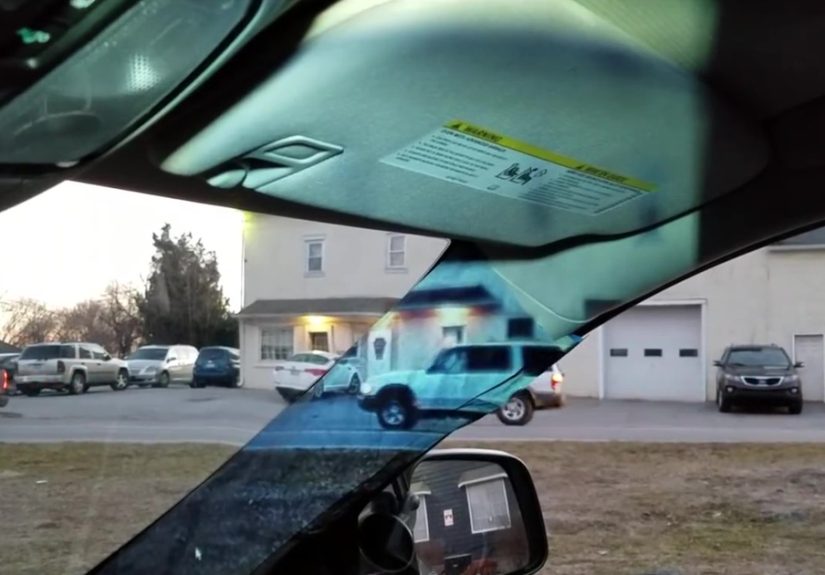
Alaina’s solution sounds like something out of a sci-fi movie, but it’s deceptively simple and
clever. Instead of trying to redesign the car’s structure, she asked: what if we could
see through it using technology?
Step 1: Put a camera where the driver can’t see
First, she mounted a small webcam on the outside of the car, aimed at the area that would
normally be blocked by the A-pillar. Think of it as giving the car an extra “eye” on the world:
the camera is looking at the road, sidewalk, and other vehicles that the driver’s own eyes
can’t see because of the pillar.
Step 2: Project the hidden view onto the pillar
Inside the car, Alaina installed a projector above the driver’s head. That projector took the
live video feed from the webcam and threw it directly onto the interior surface of the pillar.
Essentially, whatever the outside camera saw was painted right onto the place where the driver
normally sees a solid block of plastic.
The magic trick: from the driver’s seat, the pillar now appears to “open up,” showing the road,
pedestrians, or vehicles that would otherwise be hidden. To the brain, it’s as if the metal has
become invisible and you’re just looking at the world outside.
Step 3: Make the image crisp and driver-focused
If you’ve ever used a projector in a classroom, you know the image isn’t always crystal clear.
Alaina didn’t want a washed-out, fuzzy picture that distracted more than it helped. So she went
further and 3D-printed custom parts to position the projector just right and improve the focus.
She also lined the pillar with retroreflective material – a surface that bounces light back
toward its source instead of scattering it. That means the projected image is brightest for the
driver, who is sitting near the projector’s line of sight. Passengers see less glare, and the
whole thing feels like a personal heads-up display built out of everyday components.
Why her prototype feels so natural
One of the coolest things about this idea is how low-friction it is for the driver. You don’t
have to remember to press a button or stare at a tiny screen. You just look ahead like you
always do – and the visual gap disappears.
In a world where cars are getting more and more screens, beeps, and blinking icons, a solution
that just quietly improves your view without demanding extra attention is kind of refreshing.
It doesn’t try to drive the car for you. It just helps you see the world more clearly.
From science fair table to national spotlight
After testing her setup at home and documenting the results, Alaina entered it into the Broadcom
MASTERS, a prestigious STEM competition for middle schoolers in the United States. The contest
starts with tens of thousands of projects at local fairs across the country. A smaller group is
nominated for nationals, and an even smaller group gets flown to Washington, D.C. for a week of
finals, team challenges, and judging.
Her invention stood out not just because it was clever but because it addressed a real-world
problem that affects millions of drivers, cyclists, and pedestrians every day. Judges look for
creativity, scientific thinking, and the potential for impact – and a teenager turning a serious
safety hazard into a solvable design problem checks all those boxes.
In the end, Alaina took home the competition’s top honor: the Samueli Foundation Prize, worth
$25,000. Not bad for a project born from noticing that “this pillar is really annoying.”
How her idea fits into modern car safety tech
Today’s vehicles come packed with driver-assistance technology: blind spot monitoring lights in
the mirrors, lane-keeping systems that nudge you back between the lines, rear cross-traffic
alerts, and all kinds of sensors that watch for trouble.
Most of those systems work by using radar, ultrasonic sensors, or cameras to detect nearby
vehicles or obstacles. They then warn you with flashes, chimes, or steering wheel vibrations.
Some can even take action, braking or steering on your behalf in an emergency.
Alaina’s invention is different in a subtle but important way. Instead of telling the driver
what’s there, it simply shows the driver what’s there. It’s less like a nagging backseat driver
and more like removing the sunglasses you didn’t realize were smudged.
In theory, a refined version of her concept could:
- Be integrated into new cars as part of the interior design of pillars.
- Work with existing cameras that many vehicles already have for driver-assistance systems.
- Provide better visibility at intersections, roundabouts, and during left turns.
- Give extra confidence to new drivers who are still learning how to scan properly.
Automakers are always balancing cost, complexity, and reliability when they adopt new tech. But
the core idea – using cameras and projection to “undo” the visual penalty of thick pillars –
fits perfectly into the broader evolution of vehicle safety.
What the rest of us can learn from a teen inventor
The obvious takeaway is that young people can absolutely contribute to serious engineering
problems. You don’t need a PhD to notice that something is dangerous or frustrating and imagine
a better way. Sometimes you just need curiosity, a supportive environment, and the courage to
build a rough first version.
There’s also a practical lesson for drivers: technology helps, but visibility still matters.
Until cars routinely ship with invisible pillars, we can all:
- Adjust our mirrors correctly to reduce traditional blind spots.
- Lean forward slightly at intersections to peek around thick pillars.
- Double-check crosswalks and bike lanes when turning, especially in busy urban areas.
- Teach new drivers that “look over your shoulder” isn’t just a suggestion – it’s survival.
And if you’re a parent, teacher, or mentor, there’s a bigger message: kids are watching the
world and noticing problems all the time. When they say, “This seems unsafe,” that might be the
beginning of their first invention – or, at the very least, a great science fair project.
Experiences and reflections: living with blind spots
To understand why Alaina’s idea resonates so much, it helps to think about real-world moments
when blind spots turn from a technical term into a heartbeat-skipping experience. Most drivers
can remember their first serious “where did that car come from?” scare. You’re merging onto the
highway, you glance at the mirror, you start to move over – and suddenly there’s a horn, a flash
of another vehicle, and an instant jolt of adrenaline as you jerk the wheel back into your lane.
Now imagine you’re a brand-new driver, maybe 16 or 17, just getting comfortable behind the
wheel. You’re still figuring out how much space your car takes up, how far you need to turn the
steering wheel, and how to coordinate mirrors, signals, and shoulder checks. Thick pillars and
hidden vehicles make that learning curve steeper. Every small visibility improvement isn’t just
a nice convenience – it’s a little bit of anxiety taken off the table.
Parents feel this, too. Picture a mom backing a large SUV out of a crowded school parking lot at
pickup time. Kids are weaving between cars, some too short to see clearly out the rear window.
Even with a backup camera, the combination of bright sunlight, smudged camera lenses, and
bustling chaos can make it hard to spot everything. The idea that transparent pillars or more
comprehensive visibility tech could remove one more blind zone is genuinely reassuring.
Cyclists and pedestrians are on the other side of this problem. Many can tell you about the
“surprise car” that appeared halfway through a crosswalk turn or the driver who didn’t see a
bike lane because a pillar blocked the view at just the wrong moment. To them, better
driver visibility isn’t a nice gadget – it’s the difference between a smooth ride and a close
call. A system like Alaina’s that fills in the gaps around pillars directly addresses those
little moments where someone on a bike or on foot simply disappears from view.
There’s also a psychological angle: people tend to trust what they can see with their own eyes
more than a warning light or buzzer. When a car’s blind spot monitoring system flashes an
orange symbol in your mirror, you still have to interpret it. Is that a glitch? Is something
actually there? With a projected, real-world image, the driver doesn’t have to decode a symbol;
they just see the other car, the cyclist, or the pedestrian in a more natural way.
Of course, technology isn’t magic. Even the coolest projection setup won’t fix distracted
driving, phone use, or impatience. But it does change the baseline. It gives responsible drivers
a clearer view of the world, and that extra clarity can mean an earlier brake, a more cautious
turn, or a decision to wait a few seconds before changing lanes. On a busy road, those few
seconds are everything.
The deeper lesson in Alaina’s story is about how we respond to everyday frustration. Most of us
experience blind spots as just part of driving: annoying, slightly scary, but unavoidable. She
treated them as a solvable design problem. That mindset – noticing something dangerous or
inefficient in your daily life and asking, “What if it didn’t have to be this way?” – is the
foundation of innovation, whether you’re 14 or 74.
Imagine classrooms and homes where that question is encouraged often. A kid complains about
foggy bus windows; someone asks, “Could we design a better defogging system?” A teen grumbles
about how hard it is to see around a corner on their bike; a parent says, “Let’s brainstorm how
to make that intersection safer.” Not every idea will win a national prize, but every attempt
strengthens the habit of looking at the world as something you can participate in shaping, not
just something you passively endure.
In the end, “14-Year-Old Girl Finds A Way To Solve The Blind Spot Problem In Cars” isn’t just a
feel-good headline. It’s a snapshot of how future safety breakthroughs might emerge – not only
from giant research labs and corporate design studios, but from kids who notice what scares
them, care enough to tinker, and are given the tools and support to build their ideas. If a
webcam and a projector in the hands of a teenager can point toward safer roads, imagine what
happens when millions of young minds are invited to do the same.