Table of Contents >> Show >> Hide
- 1. Killer Lakes: Limnic Eruptions
- 2. Monster Walls of Water: Rogue and Sneaker Waves
- 3. Ghostly Plasma Spheres: Ball Lightning
- 4. The Endless Lightning Storm: Catatumbo Lightning
- 5. Glacial Lake Outburst Floods: When Ice Dams Fail
- 6. Fire Tornadoes: Firenadoes From Wildfire Hell
- 7. Volcanic Lightning: “Dirty Thunderstorms”
- 8. Microbursts and Downbursts: Invisible Air Hammers
- 9. Heat Bursts: Nighttime “Satan’s Storms”
- 10. Earthquake Lights: Mysterious Glows Before the Shake
- Living on a Planet With Rare but Deadly Phenomena
- Experiences and Human Stories Behind Rare Deadly Phenomena
- Conclusion: Earth’s Easter Egg Disasters
Earth is usually pretty chill: sunsets, mild breezes, the occasional cute cloud shaped like a dragon.
But every so often, the planet flips to “chaotic neutral” and unleashes something so rare and deadly
that even disaster-movie writers would say, “OK, that’s a bit much.”
These rare natural phenomena don’t happen often, but when they do, they can wipe out towns, sink ships,
spark fires, or turn a calm night into a furnace. From “killer lakes” that silently suffocate villages
to lightning storms that rage in the same spot almost every night, here are ten rare but deadly natural
phenomena that prove nature has a very dark sense of humor.
1. Killer Lakes: Limnic Eruptions
What they are
A limnic eruption sounds like a fancy spa treatment, but it’s closer to a horror movie. In certain deep,
volcanic crater lakes, carbon dioxide (CO₂) from underground magma slowly dissolves into the bottom waters.
Over years or decades, the lower layer becomes heavily loaded with gas. If something suddenly disturbs this
stratified lake — a landslide, small eruption, or even strong winds under the right conditions —
the deep water can flip, releasing a massive, invisible cloud of CO₂.
Real-world nightmare: Lake Nyos
In 1986, Cameroon’s Lake Nyos turned into a “killer lake” when it released a huge burst of CO₂ at night.
The gas, heavier than air, flowed down into nearby valleys, displacing breathable air. People and animals
simply collapsed where they were. Around 1,700–1,800 people and thousands of livestock died in a matter of
hours, without fire, flood, or any obvious warning. It remains one of the strangest and deadliest natural
disasters in recorded history.
Why it’s rare but deadly
Limnic eruptions require a very specific combo: a deep stratified lake, a steady CO₂ source from volcanic
activity, and just the right kind of disturbance. Only a few lakes on Earth are known to be at risk, but
where they exist, engineers now install degassing pipes to slowly vent CO₂ and prevent another silent catastrophe.
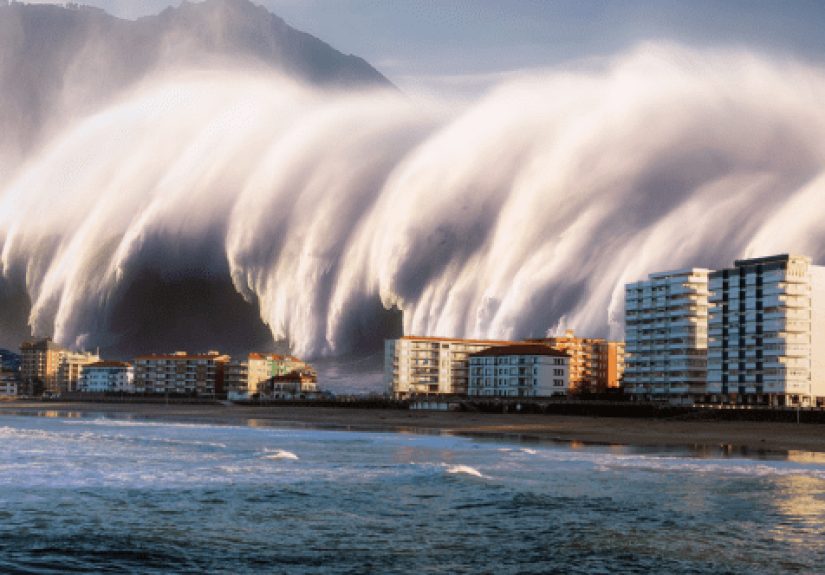
2. Monster Walls of Water: Rogue and Sneaker Waves
Rogue waves at sea
For centuries, sailors told stories of freak “walls of water” that came out of nowhere, towering twice as high
as surrounding waves and smashing ships. For a long time, scientists filed this under “probably exaggerated
sailor lore.” Then satellites and offshore platforms started measuring them for real.
Rogue waves are enormous, spontaneous ocean waves that can exceed twice the significant wave height of the sea
around them. They can slam into tankers, cruise ships, and oil platforms with enough force to shatter windows,
tear away equipment, and in some suspected cases, sink vessels outright. They’re rare at any specific point in
time, but common enough globally that they’re now a major design consideration for ships and offshore structures.
Sneaker waves on shore
Along rocky coasts, especially in places like the U.S. West Coast, “sneaker waves” are the landlubber’s version
of rogue waves. The ocean looks manageable, waves roll in at a steady rhythm… and then one huge wave surges much
farther up the beach than the others. People standing on rocks, logs, or near the waterline can be knocked down
and dragged into cold, turbulent surf in seconds.
Sneaker waves are deadly precisely because they don’t look dramatic until it’s too late. No roaring storm, no
giant tsunami warning — just one bad wave on an otherwise “pretty” day.
3. Ghostly Plasma Spheres: Ball Lightning
Imagine sitting inside during a thunderstorm, when a glowing sphere the size of a grapefruit drifts through the
air, hovers for a few seconds, then vanishes with a pop. That’s ball lightning — one of the strangest and
least understood rare natural phenomena.
Ball lightning is reported as luminous orbs that can be tiny or several feet across, often appearing during
thunderstorms. Witnesses have described them floating along power lines, rolling down airplane aisles, or
even seeming to pass through windows. They usually disappear harmlessly, but there are accounts of burns,
fires, and even explosions linked to these glowing wanderers.
Science has made progress modeling how such a plasma bubble could form, but there is still no single accepted
explanation. The good news: your chances of seeing ball lightning are extremely low. The bad news: if you do,
you’ll probably be too busy screaming to appreciate the physics.
4. The Endless Lightning Storm: Catatumbo Lightning
Over Venezuela’s Lake Maracaibo, nature runs a nightly light show that makes concert lasers look tame.
Catatumbo lightning is an almost continuous thunderstorm that flares up over the same region up to 140–160
nights a year, often for nine hours at a time, with dozens of flashes per minute.
It happens where warm, moist air from the lake meets cooler mountain air, creating a highly efficient
lightning factory in the sky. Although the phenomenon itself is localized, it means intense thunderstorm
activity, frequent lightning strikes, and associated risks for boats, local communities, and infrastructure.
Beautiful? Absolutely. Safe? Not exactly. Being on the water in a metal boat under one of the most lightning-prone
skies on Earth is not a bucket-list item you want to check off without serious precautions.
5. Glacial Lake Outburst Floods: When Ice Dams Fail
High in mountain ranges like the Himalayas, Andes, and Alps, glaciers are retreating and leaving behind
meltwater lakes held back by ice or loose rock-and-sediment dams. These glacial lakes can grow quietly for
years until something triggers a sudden failure: a landslide, glacier collapse, earthquake, or just rising
water pressure.
When the dam fails, a glacial lake outburst flood (GLOF) sends a torrent of water, ice, and debris roaring
down-valley. These floods can sweep away bridges, roads, farms, and entire settlements in minutes, sometimes
dozens of miles from the lake itself. In parts of Nepal, Pakistan, and other high-mountain regions, growing
glacial lakes are a major climate-related hazard.
GLOFs are rare at any given lake but increasingly likely overall as warming temperatures create more and larger
unstable lakes. In other words: fewer glaciers, more surprise inland tsunamis.
6. Fire Tornadoes: Firenadoes From Wildfire Hell
A wildfire is bad enough. Add tornado-like winds, and you’ve got a firenado — a fire whirl intense enough
to be classified on the same scale as regular tornadoes. These spin up when intense heat from a large fire causes
rising columns of air that begin to rotate, forming a vortex filled with flames, ash, and debris.
Most fire whirls are small and short-lived, but in extreme cases they can reach hundreds of feet high, with
winds strong enough to flip vehicles and tear apart structures. During major fires in places like California and
the American West, rare high-intensity fire tornadoes have been documented with wind speeds rivaling strong
tornadoes, causing fatalities and incredible damage.
These events are mercifully rare, requiring just the right combination of terrain, fire intensity, and atmosphere.
When they do occur, firefighters have essentially one strategy: get out of the way.
7. Volcanic Lightning: “Dirty Thunderstorms”
Volcanic eruptions are dramatic enough — lava fountains, ash plumes, booming explosions. Sometimes, they
also come with their own built-in lightning storm. Volcanic lightning (often called a “dirty thunderstorm”) occurs
when ash, rock fragments, and ice particles collide within an eruption column, building up electrical charge.
The result is lightning branching through ash clouds, turning the sky into something straight out of a fantasy
painting. Beyond the aesthetics, though, it signals a highly energetic plume. The combination of ash, lightning,
toxic gases, and sometimes pyroclastic flows makes the area near an active volcano one of the worst places you
could possibly stand.
Volcanic lightning doesn’t cause the eruption, but it does add an extra layer of hazard for aircraft and for
people attempting to monitor the volcano up close.
8. Microbursts and Downbursts: Invisible Air Hammers
Most people think of dangerous winds as swirling (like tornadoes) or steady and strong (like hurricane winds).
Microbursts and downbursts are different: they are concentrated blasts of air slamming down from thunderstorms
and spreading out at the surface in straight lines.
In a microburst, a downdraft only a few kilometers across can hit the ground and blast outward with winds that
rival or exceed those in severe tornadoes, but without the visible funnel. They can flatten trees in a radial
pattern, rip roofs off buildings, and, crucially, create sudden wind shear for aircraft on takeoff or landing.
Microbursts are relatively short-lived — often just a few minutes — and very localized, which makes
them hard to detect in time. Modern radar and pilot training have dramatically reduced the number of aviation
disasters caused by downbursts, but the underlying phenomenon remains a rare, high-impact threat.
9. Heat Bursts: Nighttime “Satan’s Storms”
Imagine it’s close to midnight, the air is pleasantly warm… and within minutes, the temperature jumps 20–30°F,
humidity crashes, and howling winds appear out of nowhere. That’s a heat burst: a rare meteorological event that
usually occurs as thunderstorms are dying out.
Here’s the short version of the physics: rain high in the atmosphere evaporates into very dry air, cooling the air
parcel and making it dense enough to plunge toward the ground. As it falls, it compresses and warms dramatically.
By the time this bone-dry air hits the surface, it arrives as a hot, gusty blast.
Heat bursts can cause damaging winds, down trees and power lines, and create dangerous fire weather conditions.
In some infamous cases, temperatures have briefly spiked into extreme territory overnight, freaking out anyone
who stepped outside expecting “cool and calm” and instead found “hair-dryer apocalypse.”
10. Earthquake Lights: Mysterious Glows Before the Shake
Reports of strange lights in the sky near major earthquakes go back centuries: blue or white flashes, sheets of
light, or glowing orbs hovering near the horizon. These “earthquake lights” are still controversial, but enough
credible reports and video evidence exist that many scientists now treat them as a real, if rare, phenomenon.
One leading idea is that stress in certain kinds of rocks can generate strong electric fields, which then ionize
the air and produce glows or flashes. Others point to possible methane ignition or interactions with the
ionosphere. Whatever the exact mechanism, these lights seem to be associated with specific tectonic settings and
only a tiny fraction of earthquakes.
Are they spooky? Absolutely. Do they help predict earthquakes? Not yet in any reliable way. For now, they’re one
more reminder that we still don’t fully understand all the ways Earth vents its stress.
Living on a Planet With Rare but Deadly Phenomena
Fortunately, you’re unlikely to personally encounter any of these phenomena. But “unlikely” is not the same as
“impossible,” especially if you live near mountains, volcanoes, glaciated valleys, or wild coasts, or you work in
aviation or maritime industries.
- Take local hazards seriously. If your region has a history of glacial floods, sneaker waves,
or killer lakes, heed warning signs and evacuation advice. They’re there because something bad already happened. - Respect the ocean. Never turn your back on the surf, avoid standing on wet or isolated rocks,
and don’t assume a calm day means safe conditions. - Wildfire and storms: If emergency services say conditions are extreme, don’t try to stay and
“just film it for social media.” Firenadoes and microbursts are not impressed by your follower count. - Plan for climate-driven risks. As glaciers retreat and weather patterns shift, some of these
rare hazards — especially GLOFs and extreme convective events — may become more frequent in certain
regions.
Experiences and Human Stories Behind Rare Deadly Phenomena
Numbers and physics make these events easier to understand, but it’s the human experiences that really drive home
how surreal they are. Survivors often describe a sense that reality itself briefly “broke.”
People who lived through the Lake Nyos disaster, for example, recalled waking up to eerie silence and fog, only to
realize neighbors, animals, and entire households were motionless. Many reported headaches and confusion before
losing consciousness. Rescue teams arriving later found scenes that looked like time had been paused mid-sentence:
people collapsed in doorways, meals left uneaten, animals lying where they had been tethered. The shock wasn’t just
the death toll, but the absence of obvious destruction — no fire, no water, no rubble, just an invisible gas
that had quietly displaced breathable air.
Coastal communities familiar with sneaker waves tell similarly unsettling stories. A family might be posing for a
photo on what appears to be a safe stretch of wet sand, when a single larger wave rushes in, knocks them off their
feet, and pulls one or more people into deeper water. Survivors often say the day didn’t “feel dangerous” at all —
no storm, no warning sirens, just a few seconds where the ocean suddenly changed its mind.
In mountainous regions, villagers exposed to glacial lake outburst floods talk about a distant roar that built into
something like a freight train or jet engine. By the time people saw the wall of water and debris racing down-valley,
there were often only minutes — or seconds — to run to higher ground. Afterward, the landscape could be
unrecognizable: roads torn away, fields buried in rock and mud, bridges snapped like twigs. For many, the hardest part
is that the disaster came from a lake they had watched in the distance for years, assuming it was harmless.
Pilots who have encountered microbursts and severe downbursts describe instruments suddenly “going crazy” during
approach: rapid gains and losses in airspeed and altitude, alarms sounding, and the unsettling feeling that the
airplane is no longer responding as expected. Modern training emphasizes recognition and escape techniques, but
the stories from earlier decades — when microbursts weren’t well understood — helped drive changes in
radar technology, procedures, and airport weather monitoring.
Then there are the more “cinematic” experiences, like witnessing volcanic lightning or earthquake lights. People
who’ve seen volcanic lightning up close talk about feeling both terrified and awestruck: jagged bolts lacing
through ash clouds, illuminating an eruption plume that already looked otherworldly. Those who have captured
earthquake lights on video often admit they first assumed they were seeing transformers explode or normal
lightning — only later did they realize the flashes seemed to line up with seismic waves or occur before
the shaking.
Collectively, these stories underline a simple truth: rare natural phenomena are not just curiosities in science
papers or cool photos on the internet. They’re part of the lived experience of people in specific regions, often
shaping local myths, safety culture, and long-term planning. And while you may never personally encounter a killer
lake, firenado, or night-time heat burst, understanding them helps us design better warning systems, stronger
infrastructure, and smarter evacuation plans — so the next time Earth does something weird, more people
get to walk away and tell the story.
Conclusion: Earth’s Easter Egg Disasters
These rare but deadly natural phenomena are like Earth’s hidden “Easter eggs” — bizarre, powerful events
that only show up when the right conditions align. Limnic eruptions, rogue waves, ball lightning, Catatumbo
storms, glacial floods, firenadoes, volcanic lightning, microbursts, heat bursts, and earthquake lights all
remind us that our planet is still full of surprises.
The upside? We’re getting better at understanding and monitoring these hazards. The more we learn, the more we
can turn “freak disaster” into “known risk” — and that shift can save lives. Until then, it doesn’t hurt
to keep a healthy respect for deep volcanic lakes, stormy coasts, dark thunderclouds, and strangely hot midnight winds.